Game Porting Services


In porting outsourcing services the goal is simple: get the game in front of players on platforms the original build never touched, since that is usually where the easiest, fastest revenue is sitting unclaimed.
Kevuru Games is an expert in porting games between platforms and we are willing to demostrate you why below
What Is Game Porting?
A game keeps its mechanics, its feel, its identity, but gets moved onto hardware it was never built for in the first place. That’s porting. Certification rules change. Memory budgets shrink, or sometimes expand, depending on the target. Controls need entirely new input schemes. None of that happens if someone just recompiles the code and calls it done.
Platform-Specific Porting (Console, Mobile, PC)
Console game porting services run into hardware limitations and store policies that vary by platform. Move a PC build to console, and now it has to squeeze into a fixed memory budget, then clear an approval process the PC version never had to sit through. Mobile is worse. Less power, a smaller screen, and the whole control scheme has to get rethought from scratch, not just shrunk down to fit.
That platform matters: mobile alone accounts for 55 percent of global gaming revenue, against 24 percent for console and 21 percent for PC, according to Newzoo’s 2025 Global Games Market Report.
Engine-Specific Porting (Unreal, Unity, Custom)
Unreal and Unity already ship with the platform modules built in for the major targets, so that part is mostly done for you. Custom, in-house engines get none of that. Every rendering layer, every input layer, written by hand, for every single platform, every time.
Console-to-Mobile: Key Differences
Porting a console game to mobile services means a gamepad and a touchscreen are not asking for the same thing. So this particular jump needs a real redesign, not a quick remap job. GPU budgets shrink hard in the process. And because mobile hardware varies so widely, one phone running the game well says almost nothing about the next ten.
We Port Games To These Key Platforms

#PC

#CONSOLE

#Mobile



Our Top-rated
Projects
Poppy Playtime
- Porting Poppy Playtime: Chapter 2 from PC to PS4, PS5, Xbox One and Xbox Series X|S
- Upgrading the project from Unreal Engine 4.27 to 5.4 and rebuilding the physics system
- Replacing ray-traced dynamic lighting with baked static lighting that keeps the original atmosphere
- Optimizing level geometry and light maps, and combining static meshes to cut draw calls
- Reworking shaders, reducing character polycount, simplifying rigs and hair for console budgets
- Adapting controls and UI for gamepad play and fixing video playback on PS4
- Certifying and releasing on four platforms in five months
Star Wars
- VR-based action-adventure game based on the legendary franchise
- Creating 3D characters with texture variations
Fortnite
- Iconic free-to-play Battle Royale game with over 400 million players worldwide
- Creating concept art for character skins
Iron Order 1919
- Cross-platform strategy game for mobile devices and browser
- Creating 3D models of mechs and soldiers, as well as their animations
Birdly
- VR-based hyperrealistic immersive butterfly flight simulator
- Creating ultra-realistic 3D models of insects, birds, and plants, as well as their animations
MechaChain
- Web3 game development
- Working on game design, art , sounds and engineering part
Undead Blocks
- The world’s first AAA play-to-earn zombie shooter game on the Ethereum network
- Creating 3D models of zombies, weapons, and environment, composing the music





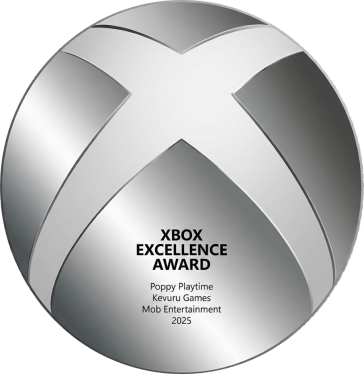
certified excellence: xbox award winner 2025
Proud recipients of the Xbox Excellence Award for our outstanding work porting Poppy Playtime to console.
How Game Porting Works: Our Process
Code & Engine Overhaul

Performance Domination

Rendering pipelines get fine-tuned, asset compression gets tightened, and we profile the build repeatedly through the process. A single optimization pass rarely catches everything a full platform switch exposes.
Graphics & Assets Adaptation

We build in scalable graphic settings, optimize lighting and rendering pipelines for each device’s capability, and test transitions between performance modes so switching quality settings mid-session does not cause a visible stutter.
Controls & UI Reinvention

Testing, Certification & Launch

From there, we manage the certification process for consoles and mobile stores directly, handle final release preparation, and stay on through post-launch support. The first week after launch is usually where real device fragmentation shows up.
Performance Optimization: Why It Matters
A port that runs is not the same as a port that runs well. Frame rate drops, memory overruns, and GPU bottlenecks are the most common reasons a ported game gets review-bombed by players even after passing certification.
Console dev kits cost $5,000 to $10,000 per unit, and that hardware exists specifically to catch performance problems before a real player does. Skipping proper performance profiling to hit a launch date usually costs more in post-launch patches and refunds.
Not every game is a good fit for game porting services, and not every studio needs to hear that from a vendor with an incentive to say yes. If your title has a locked core loop and a genre where reaching a new platform’s audience is worth the investment, game porting services can extend a game’s revenue well past its original launch window.
If the codebase is deeply tied to one platform’s architecture, a rebuild may cost less than forcing a port. Either way, an honest answer is worth more than an optimistic one. Want to find out which category your project falls into?
Get a Free Porting AssessmentOur Fundamental Benefits in Game Porting

Effective Team Composition

Saving Gameplay Features

Transparent Management

Complete Compliance Support
Technical Debt & Common Porting Pitfalls
Game porting services do not fix bad architecture. They expose it. A handful of real risks appear when porting starts:
Nintendo Switch ports commonly run into GPU memory constraints that reduce visual quality if optimization starts too late in the process. Mobile fragmentation, thousands of device and OS combinations, means true 100 percent device certification is not realistic. We aim for broad, tested coverage instead of an impossible guarantee.
Games built with deep, engine-specific dependencies can be cost-prohibitive to port at all, and the honest answer sometimes is that a rebuild costs less than a port would.
We believe first-attempt certification should be the default expectation, not a stretch goal. A first Sony TRC or Xbox certification review alone takes 4 to 8 weeks. Failing it does not just cost that time; it costs the same review cycle again. Studios that treat certification as a final QA pass rather than a design constraint from day one are the ones who end up resubmitting.