The biggest game development trends in 2026 reflect how quickly the industry is evolving. Artificial intelligence, cross-platform development, creator platforms, mobile gaming, and live-service experiences are reshaping both production pipelines and player expectations. Understanding these trends helps studios build games that remain competitive in an increasingly crowded market.
Gaming Industry by the Numbers
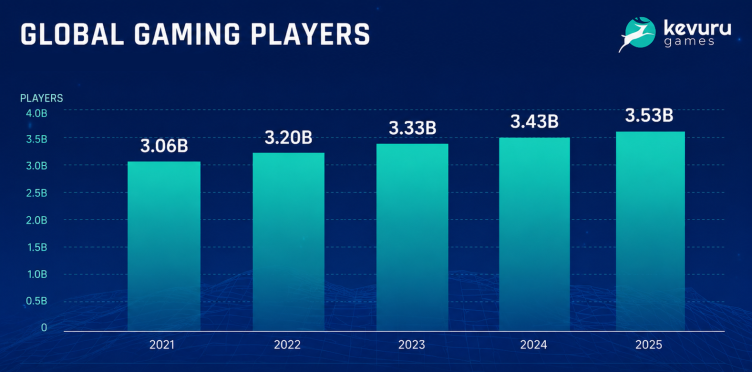
According to Statista data, in 2025, the number of players has reached 3.5 billion.
A player is anyone who has played games on a PC, console, or mobile device in the last 6 months.
| Year | Players | Annual growth | Annual growth, % |
| 2021 | 3.06 billion | +178 million | ↑ 6.2% |
| 2022 | 3.20 billion | +141 million | ↑ 4.6% |
| 2023 | 3.33 billion | +130 million | ↑ 4.1% |
| 2024 | 3.43 billion | +102 million | ↑ 3.1% |
| 2025 | 3.53 billion | +100 million | ↑ 2.9% |
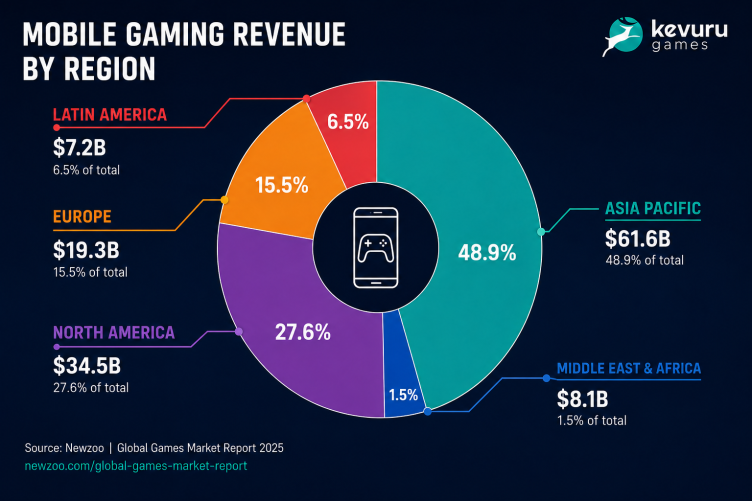
The Asia-Pacific region spends the most money on games: it accounts for $90 billion of total revenue, over $45 billion of which comes from China.
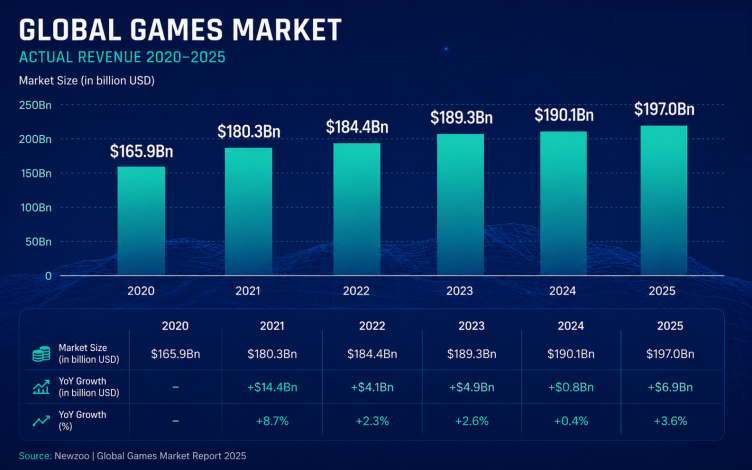
The global games market reached approximately $197 billion in 2025, according to Newzoo. This is almost three times larger than the global music industry and several times larger than the worldwide theatrical box office.
More than half of the entire gaming industry’s revenue comes from mobile games. The main trend today is not one-time purchases, but attracting paid players who donate at one time or another to get loot boxes, characters, additional levels, etc.
According to Sensor Tower’s State of Mobile Gaming, games continue to generate the largest share of consumer spending on mobile, with in-app purchases remaining the primary monetization model across the industry.
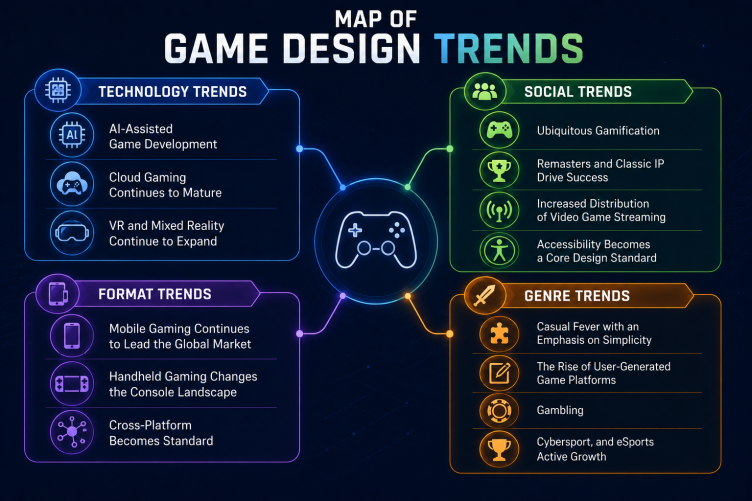
So, what upcoming gaming trends can we identify now? We have created a map to make it easier for you to navigate in our subsequent structural systematization of the most significant trends of the next year.
Technology Trends
State-of-the-art technological developments and innovations that are about to enter the market or already exist and are preparing for large-scale modification and expansion.
AI-Assisted Game Development
Artificial intelligence has moved from experimentation to everyday production workflows. According to the 2025 State of the Game Industry report, 52% of developers now work at companies that use generative AI tools, while 36% use them personally. At the same time, enthusiasm has become more measured: fewer companies describe themselves as actively interested in adopting AI than a year earlier, suggesting the conversation has shifted from hype to practical implementation. AI is used in coding assistance, concept exploration, 3D asset generation, and automating repetitive production tasks, but no one expects it would magically generate a game from scratch.
For game developers, the competitive advantage is no longer simply using AI—it’s integrating it into production responsibly. The studios seeing the greatest benefits are those combining AI-assisted workflows with experienced artists, designers, programmers, and producers who maintain creative direction and technical quality throughout development.
If you’re curious to see what an AI-assisted pipeline in 3D art looks like, check out the story about how our artists save time with AI tools while maintaining full creative control and high quality.
Related Content:
✔ Metaverse, Robotics, and AI: The Evolution of 3D Game Modeling
Cloud Gaming Continues to Mature
Cloud gaming has evolved from an emerging technology into a stable part of the gaming ecosystem. Instead of replacing traditional hardware, it complements it by allowing players to stream games across PCs, smartphones, smart TVs, handheld devices, and consoles without high-end local hardware.
Unlike a few years ago, when the market was still experimenting with different business models, today’s cloud gaming landscape is led by services such as Xbox Cloud Gaming, NVIDIA GeForce NOW, Amazon Luna, and Boosteroid. Rather than focusing solely on technology, these platforms compete through game libraries, ecosystem integration, and player convenience.
For studios, cloud gaming changes more than distribution. It encourages scalable backend infrastructure, live-service support, and continuous content updates, while reducing hardware barriers for players. As internet infrastructure continues to improve worldwide, cloud gaming is becoming an additional way to reach audiences rather than a replacement for traditional gaming.
Related Content:
✔ 5 Most Exciting Gaming Technology Trends [+ Special Bonus Trend That-Must-Not-Be-Ignored]
VR and Mixed Reality Continue to Expand
Virtual reality is no longer limited to gaming enthusiasts. Today, VR and mixed reality technologies are widely used across entertainment, education, healthcare, manufacturing, architecture, and professional training, creating new opportunities for developers beyond traditional games.
Consumer devices such as Meta Quest 3, Meta Quest 3S, and Apple Vision Pro have accelerated the adoption of immersive experiences, while improvements in standalone hardware make high-quality VR accessible to a broader audience. At the same time, developers are increasingly creating experiences that combine virtual and physical environments through mixed reality rather than relying on fully isolated virtual worlds.
For game studios, this evolution raises the technical bar. Assets designed for VR require high visual fidelity while maintaining stable real-time performance. Careful optimization of geometry, textures, lighting, and interactions becomes essential, since users can inspect environments and objects from extremely close distances. At Kevuru Games, we love working with VR. One of our VR projects, Birdly, received a NYX award.

Social Trends
How the gaming component is becoming a part of all spheres of society, video activities are spreading, and players’ gaming expectations are changing.
Ubiquitous Gamification
Games are no longer just entertainment. Virtual worlds are becoming a new platform for communication. People use them for different purposes.
| Fitness | Peloton motivates users through achievements, streaks, leaderboards, and community challenges, turning everyday workouts into engaging long-term goals. |
| Healthcare | SuperBetter applies game mechanics such as quests, power-ups, and achievements to help users build resilience, improve mental wellbeing, and recover from health challenges. |
| Community-driven services | Waze rewards users for contributing real-time traffic reports, road hazards, and map updates through points, rankings, and status levels, helping maintain one of the world’s largest crowdsourced navigation platforms. |
| Museums & education | Projects like Birdly transform museum visitors from passive observers into active participants through immersive VR experiences that combine education with gameplay-inspired interaction. |
| Education | Khan Academy uses mastery levels, badges, progress tracking, and personalized learning paths to keep students engaged and encourage continuous improvement. |
In the future, games will also transform the education system. Of course, they will not replace the lessons entirely, but rather become an addition to them/ The skills learned in the games will be applied both at school and at work. For example, researchers from the University of Glasgow have found that games develop critical and reflective thinking, and also have a positive effect on the reaction. They even point out that games can help a person find a job. Unless, of course, one abuses the duration of gaming sessions.
Remasters and Classic IP Drive Success
Revisiting established franchises remains one of the safest and most successful strategies in modern game development. While players continue to look for original experiences, they also respond strongly to familiar worlds, iconic characters, and proven gameplay that can be enhanced with modern technology.
Recent releases such as The Elder Scrolls IV: Oblivion Remastered, Silent Hill 2 Remake, Resident Evil 4 Remake, and Dead Space have demonstrated that high-quality remasters and remakes can perform as well as entirely new releases. For publishers, these projects reduce creative risk while introducing classic franchises to new generations of players.
Increased Distribution of Video Game Streaming
Game streaming is taking over the industry more and more. With the advent of one-click live game streaming, open-source capture and broadcasting tools, the number of hours spent watching game video has skyrocketed. Competitive games create unique gaming experiences that are actively shared and watched by millions. It engages people more than sporting events and revives interest in old classics like Heroes of Might and Magic III.
Game streaming has evolved into one of the industry’s primary content channels. Platforms such as Twitch, YouTube Live, and TikTok Live allow developers, creators, and esports organizations to reach global audiences while building highly engaged communities around their games.
Related Content:
✔ Best Games to Stream on Twitch: Top Titles for Professionals & Beginners
Accessibility Becomes a Core Design Standard
Accessibility is no longer treated as an optional feature added late in development. It has become a core part of game design, helping studios reach broader audiences while improving the experience for all players.
Modern games increasingly launch with features such as customizable controls, scalable UI, subtitles, colorblind modes, difficulty adjustments, screen readers, and audio accessibility options. Many publishers now include accessibility requirements in production planning from the earliest stages, making them part of design, UI/UX, QA, and localization workflows.
Beyond meeting player expectations, accessibility also makes business sense. Designing for a wider range of players expands the potential audience, improves player retention, and helps studios comply with platform guidelines and industry best practices.
Format Trends
The evolution and potential of gaming platforms, in-game changes in receiving bonuses, and uniting players with different hardware.
Mobile Gaming Continues to Lead the Global Market
Mobile gaming remains the largest segment of the global games industry, generating more revenue than PC and console individually. According to the Newzoo Global Games Market Report 2025, mobile games account for more than $100 billion in annual revenue, making smartphones the primary gaming platform for billions of players worldwide.
The market, however, has become far more competitive. Success is no longer driven by downloads alone. Leading mobile games invest heavily in live-service features, seasonal events, social mechanics, and cross-platform progression to keep players engaged over the long term. Titles such as Honor of Kings, MONOPOLY GO!, Whiteout Survival, and Last War: Survival demonstrate that long-term player retention has become just as important as user acquisition.
At the same time, the distinction between mobile and traditional gaming continues to fade. More publishers now launch games simultaneously on mobile, PC, and consoles, allowing players to switch between devices while keeping their progress synchronized. As cross-platform development becomes more accessible, mobile is increasingly treated as part of a broader ecosystem rather than a standalone platform.
Handheld Gaming Changes the Console Landscape
The console market is no longer defined solely by traditional home systems. Handheld gaming has experienced a major revival, driven by devices like the Steam Deck, Nintendo Switch 2, ASUS ROG Ally, Lenovo Legion Go, and MSI Claw. Together, these platforms have blurred the line between PC and console gaming, allowing players to access their libraries wherever they are.
This shift has also influenced how games are developed. Studios increasingly optimize titles for different performance profiles, screen sizes, and input methods from the start of production rather than treating handheld support as an afterthought. Technologies such as dynamic resolution scaling, upscaling, and flexible graphics presets have become standard parts of the development process.
For publishers, handheld devices represent more than another platform. They extend the reach of existing games while strengthening cross-platform ecosystems built around shared accounts, cloud saves, and synchronized progression. As portable hardware continues to improve, developers are increasingly expected to deliver a consistent experience whether players are sitting at a desktop PC, using a console, or playing on a handheld device.
Cross-Platform Becomes Standard
Cross-platform support is no longer a premium feature—it has become the expectation for many multiplayer and live-service games. Players want to continue the same game across PC, consoles, handheld devices, and mobile while keeping their progress, purchases, and friends list synchronized.
The growing demand for multiplayer games dictates the need to connect players across multiple consoles and PCs. The developers were faced with the need to introduce new solutions and search for crossplay opportunities. Modern players expect more than cross-play. Cross-progression, cloud saves, and unified accounts allow them to switch between devices without losing progress. Games such as Fortnite, Diablo IV, Genshin Impact, and Call of Duty demonstrate how seamless progression has become an important part of the player experience.
Genre Trends
Key gaming genres that are gaining momentum in 2026 and extending their influence into 2027, as well as the prospects for gambling and eSports.
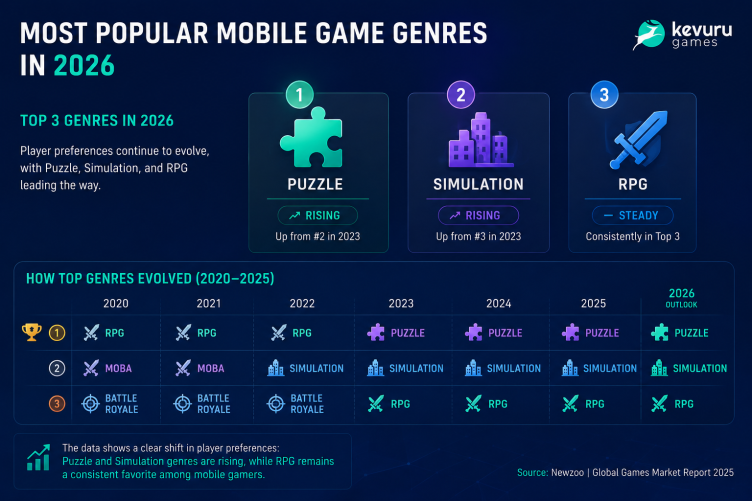
Trends in genres come and go just like any other fashion. Remember when in 2020 everyone was crazy about online multiplayer games because people were craving social interaction most during the pandemic? Since then, that craze has lowered, but hypercasual games of subgenres like interactive novels, puzzles, simulation took a more prominent place than before.
Related Content:
✔ About Profitable Hyper Casual Games: Design Tips, Rates, and Upcoming Trends
However, despite the growing popularity of casual and hybrid-casual games, MOBA remains one of the highest-grossing gaming genres thanks to titles such as Honor of Kings, League of Legends: Wild Rift, and Mobile Legends: Bang Bang. While the genre is no longer expanding at the explosive pace seen a decade ago, it continues to generate billions in player spending and maintains one of the largest competitive ecosystems in gaming. Rather than competing with casual games, MOBAs now coexist alongside them, serving a different audience with deeper progression, strategic gameplay, and long-term player engagement. But let’s talk about everything in order.
Casual Fever with an Emphasis on Simplicity
The creeping expansion of casual games, which gradually pushed multiplayer games out of the top of the rankings, continues today. While competitive and live-service titles remain hugely popular, casual and hybrid-casual games dominate mobile downloads thanks to their short gaming sessions, accessible gameplay, and broad audience appeal.
According to Sensor Tower’s State of Mobile Gaming 2025, Honor of Kings remains one of the world’s highest-grossing mobile games, while titles such as MONOPOLY GO!, Last War: Survival, and Whiteout Survival have demonstrated how casual mechanics combined with live-service progression can generate enormous commercial success.
The Rise of User-Generated Game Platforms
One of the biggest shifts in modern game development is the growth of user-generated content (UGC). Instead of consuming content created only by developers, players increasingly build their own maps, game modes, cosmetics, and entire experiences inside existing ecosystems.
Roblox remains one of the strongest examples of this trend, but it’s no longer alone. Platforms such as Fortnite through Unreal Editor for Fortnite (UEFN), Minecraft Marketplace, and Core have expanded the creator economy by giving developers and players professional-grade tools to publish content and monetize their work.
For studios, this changes production priorities. Instead of shipping a single finished product, many projects are now designed as long-term platforms that can continuously grow through community-created content, seasonal updates, and live-service support. This shift is creating new opportunities for game developers, artists, and outsourcing studios to contribute content beyond traditional game production.
Gambling, Cybersport, and eSports Active Growth
The growth of loyalty and the legalization of online casinos continue to contribute to the development of the gambling industry. At the same time, the iGaming business follows the broader gaming trend: almost every online casino now offers dedicated mobile applications or fully optimized browser experiences, making mobile the primary platform for many players.
The evolution of slot games is also interesting. While they were once considered primarily single-player experiences, many modern titles now incorporate tournaments, social features, shared jackpots, and multiplayer mechanics that encourage players to compete or participate together.
Competitive gaming has also continued to evolve. Franchises such as League of Legends, Counter-Strike 2, VALORANT, and Call of Duty remain among the biggest esports titles, supported by professional leagues, international tournaments, and millions of online viewers. Publishers continue investing in long-term esports ecosystems that strengthen player communities and extend the lifespan of their games.
At the same time, esports content is no longer limited to dedicated tournament broadcasts. Live streaming through Twitch, YouTube, and TikTok Live has made competitive gaming more accessible than ever, allowing creators, professional players, and tournament organizers to reach global audiences.
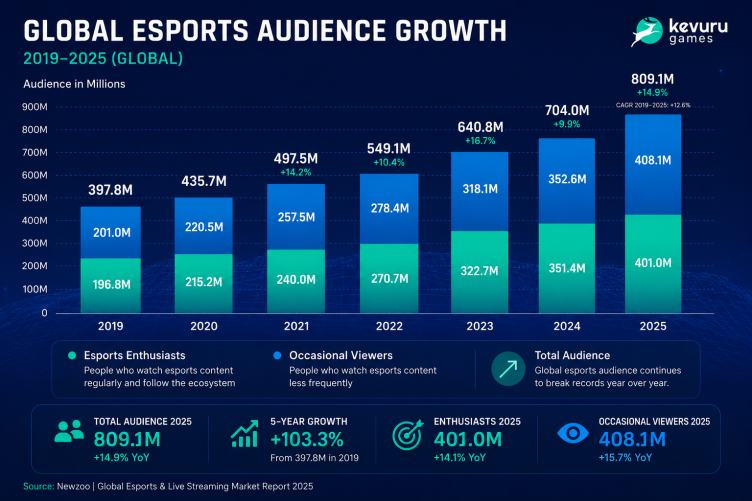
Competitive gaming continues to attract massive global audiences. According to Esports Charts, the biggest esports tournaments regularly reach millions of concurrent viewers, with League of Legends, Mobile Legends: Bang Bang, Counter-Strike 2, and VALORANT remaining among the world’s most-watched esports titles. The continued growth of streaming platforms and international competitions keeps expanding esports beyond a niche audience and further strengthens its position within the global entertainment industry.
The Future of Game Development
Gaming industry have always been largely affected by trends. Some of them are momentary, while others last for years. In this article, we have highlighted game design trends of 2026 that are affecting the industry most and will continue to do so in the years to come, the ones that matter most to developers and publishers.
And while the gaming industry is developing in its own way, we at the Kevuru Games company continue to work diligently on new projects designed to brighten up the expectation of getting rid of a dangerous new threat. To create without limits, skillfully balancing the target and economic expectations of customers, player preferences and new trends — that’s why we have gathered in a close-knit, passionate, and inspired team.
Kevuru Games is a game art and development company that implements mind-blowing projects for anyone looking to shake up the gaming space. We work with major world-renowned game video companies such as Epic Games, EA, and Lucasfilm, as well as enthusiastic indie studios and solo developers. Our team follows game development trends to always stay on top of the wave, as we are happy to adopt new things in our workflow. We have introduced AI-assisted pipelines into our work, and our team are experts at cross-platform game development. We believe that every studio builds the future of game design. Drop us a line to find out how we can help bring your idea to life.
Let’s create beyond the limits together!