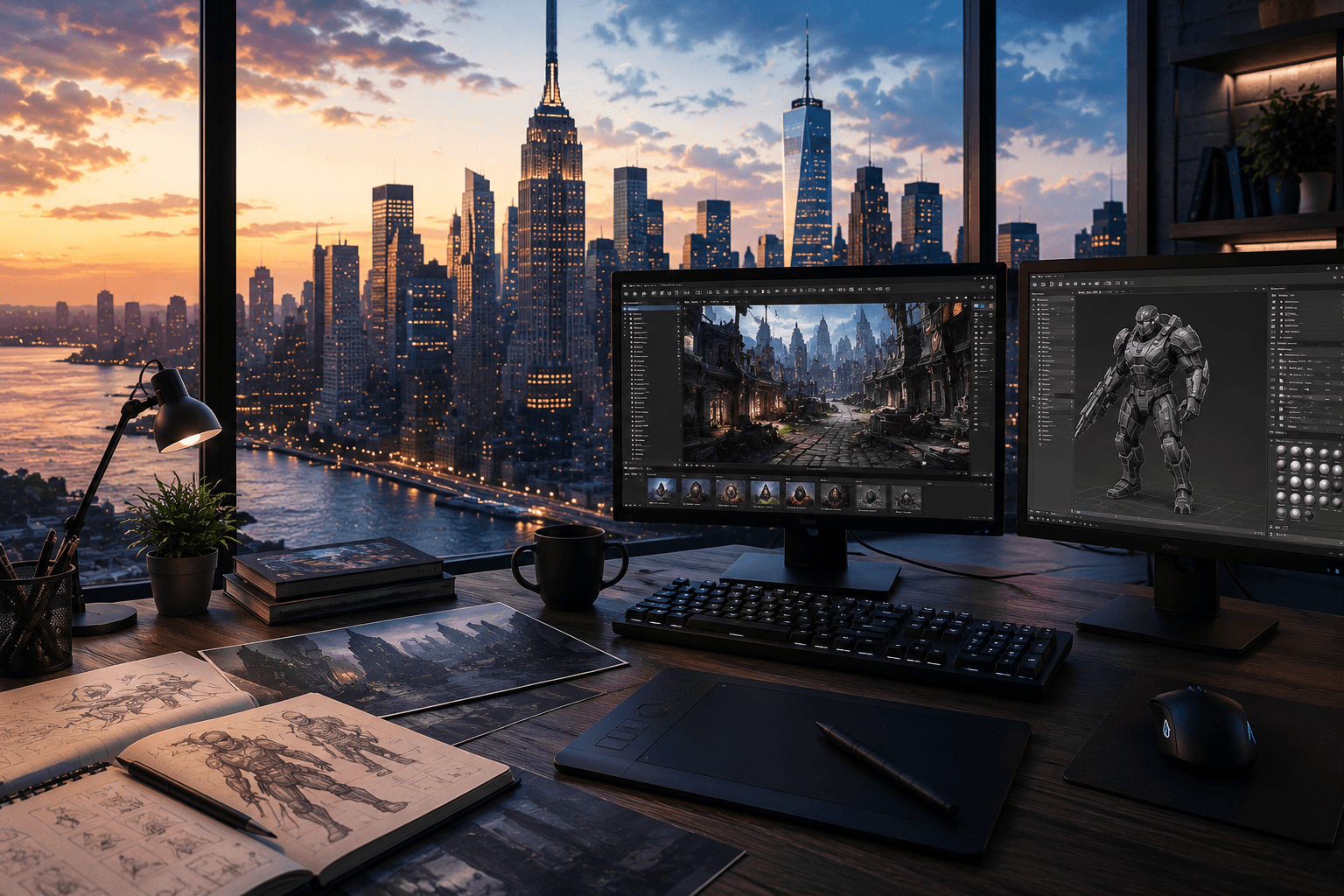
New York is not usually the first city people mention when talking about game development, but the market has grown steadily over the last decade. A big part of that comes from how closely games in New York intersect with other industries already established there – media, entertainment, advertising, animation, and tech.
That mix changes the type of projects local studios work on. Alongside traditional game development, there’s a strong focus on interactive experiences, live-service products, branded content, multiplayer systems, and cross-platform entertainment.
Another factor is talent concentration. There are many other developed creative industries, so talent moves around more freely than in many other markets. People shift between games, animation, media, film, advertising, and interactive tech, and that tends to shape how local studios build their teams.
The local market reflects that mix. Publishers, indie developers, outsourcing teams, mobile studios, and XR companies all operate alongside each other. For clients, that usually means more flexibility – both in the type of expertise available and in how production can be structured.
From the client side, that usually means there’s more room to find specialists for a specific part of development instead of forcing everything into one studio structure. Some teams focus mostly on engineering, others on art production, multiplayer systems, mobile, or live operations.
Top Game Development Companies in New York
The New York game development market includes a mix of full-cycle studios, outsourcing teams, entertainment companies, and highly specialized developers. Some focus on mobile or live-service products, others work on console, XR, or large-scale content production.
The companies below were selected based on portfolio quality, technical capabilities, production range, and market presence in 2026.
Kevuru Games
Known primarily for large-scale art production and co-development, Kevuru Games works across game development, animation, porting, and full-cycle production. The company has contributed to projects connected with studios such as Epic Games and Lucasfilm, while also working with independent and mid-sized teams on external development and production support.
Its structure combines engineering, art production, animation, UI/UX, and technical support within the same pipeline, which helps when development and content creation need to move at the same pace.
Crunchyroll
Crunchyroll comes from the anime and streaming side of entertainment, but games have become a larger part of the company over time. Most of its gaming projects are connected to existing anime franchises, particularly in mobile and online formats.
The company operates differently from a traditional game studio. Its strength comes less from standalone development and more from the larger ecosystem around publishing, distribution, licensing, and live-service support.
Its position inside the entertainment industry gives it access to cross-media production pipelines that few traditional game studios operate at the same scale.
FlyBy Media
FlyBy Media focuses on spatial computing, AR, and immersive interactive experiences. The company became known for work around mobile AR technologies and location-based systems, operating closer to the intersection of gaming and emerging interactive platforms.
Compared to traditional game studios, the company’s expertise is more technical and platform-oriented, with emphasis on real-world interaction systems and experimental user experiences.
Why Kevuru Games Is One of the Best Game Development Companies in New York
A lot of studios stay focused on one area of production. Some mainly handle engineering, others work mostly with art, live operations, or mobile projects. Kevuru Games operates across several of these areas at once, which changes how projects can be structured.
The company works across full-cycle development, co-development, art production, animation, and porting. That makes it easier to support projects where multiple parts of production need to move together instead of being split between separate vendors.
This becomes especially useful during active production phases, where development, content creation, optimization, and technical support often overlap rather than happen one after another.
Another factor is production scale. The company has experience working both with large entertainment brands and with smaller teams that need external support during active production phases. That range changes how projects are structured internally, especially when timelines are tight or the workload shifts during development.
Kevuru Games also operates closer to long-term production support than short outsourced tasks. Instead of handling isolated assets only, the studio often works directly inside existing pipelines, adapting to the client’s workflows, engine setup, and production processes.
This becomes especially relevant for projects that need flexible scaling. Teams can expand around specific stages like content production, optimization, porting, or live-service support without rebuilding the whole production structure internally.
The studio’s work across PC, console, mobile, and cross-platform projects also makes it easier to support games that move between platforms or require parallel production for different environments.
Key Services Offered by New York Game Development Companies
The New York market covers a fairly wide range of game development services. Some studios focus on full production, while others work as external partners supporting specific stages of development.
What companies offer usually depends on how their teams are structured and which part of production they specialize in.
Custom Game Development
Many New York studios work across full-cycle development, taking projects from prototype stage through release. Depending on the studio, the scope can look very different. Some teams mainly handle engineering and backend work, others focus more on multiplayer systems, platform integration, or technical support during production.
There’s also a noticeable split in specialization. Some companies stay close to mobile and live-service development, while others work more heavily with PC, console, and cross-platform projects.
Art, Animation, and Design Support
Art production remains one of the biggest areas of external support in game development. Studios in New York often provide 2D/3D art, concept design, animation, UI, VFX, and technical art for both ongoing productions and standalone content pipelines
A lot of this work happens inside existing development structures rather than separately from them. Teams are often brought in to scale production during heavier stages without expanding the client’s internal department.
LiveOps, QA, and Post-Launch Services
For games that continue evolving after release, many studios remain involved after launch as well. The work usually moves toward updates, balancing, QA, optimization, analytics, event support, and ongoing platform maintenance.
This part of production has grown significantly over the last few years. In multiplayer and live-service projects especially, launch is usually not the end of development, but the point where ongoing support starts becoming part of the process.
How We Evaluated the Best Game Development Companies in New York
New York has a pretty wide mix of game companies, and they often work very differently from each other. Some are closer to traditional development studios with internal production teams, while others operate more like external partners that plug into projects during specific stages.
For this list, the goal was not just to collect recognizable names, but to look at how these companies actually operate and what kind of production they are built for.
Portfolio Quality and Technical Expertise
One of the main things we paid attention to was the actual production background behind the studio. Some companies spend years working on the same type of projects, while others handle very different kinds of production depending on the client and platform.
Technical range also matters. Studios handling console, multiplayer, cross-platform, or live-service projects usually operate with different production requirements than teams focused only on smaller mobile titles.
Another important factor is whether the company works only on isolated tasks or can support larger parts of production when needed.
Client Feedback and Market Reputation
Public reputation was also considered, but not just in terms of ratings. Long-term partnerships, repeat collaborations, and involvement in recognizable projects tend to say more about how a studio works over time.
The market itself also matters. Some companies are known mainly inside indie circles, others operate closer to large publishers, media companies, or external production pipelines. Both models can work well, but they serve different types of projects and clients.
How to Choose the Right Game Development Company in New York
A lot of studios start looking similar once you compare portfolios and service pages. Most studios look reliable before the work begins. The real difference usually appears once the project is already in motion. Feedback starts coming from different sides, priorities shift, deadlines move, and the production process stops looking clean on paper.
Budget, Scope, and Communication Factors
Before choosing a studio, it helps to understand where the pressure points of the project are likely to be. Some teams are better suited for full development, while others work more effectively as external support added to an existing pipeline.
Scope matters here more than company size. A smaller specialized team can sometimes move faster than a large studio if the project is focused and well-defined.
Communication also tends to affect production more than people expect. Projects usually move more smoothly when the production process is already organized from the start – feedback, reviews, milestones, and tracking systems tend to matter more once the workload begins to grow.
It also helps to pay attention to how flexible the team structure is. Some projects stay stable from beginning to end, others expand or shift during production. Studios that can scale support around different stages tend to adapt better when priorities change.
Technical fit matters too. A company experienced with mobile live-service games may not be the best match for a console co-development project, even if both fall under “game development.”
In practice, the best partnership usually comes from alignment between the project and the way the studio already operates, not just from portfolio quality alone.
Final Thoughts on Hiring a New York Game Development Studio
New York has a broader mix of game companies than people often expect. Large publishers, outsourcing teams, indie developers, mobile studios, and interactive media companies all operate inside the same market, which creates a lot of variation in how projects are handled.
That also means there’s no single “best” studio for every project. Some teams are set up for full development across longer production cycles, while others are more effective when handling specific parts of production like art, multiplayer, LiveOps, or porting.
In practice, projects usually run better when the studio’s existing workflow already matches the way the project needs to operate. Teams that already operate in a similar way tend to adapt faster and create fewer problems once production gets underway.
A lot of production problems also start long before development itself. Unclear scope, unstable feedback loops, and shifting priorities tend to affect timelines more than the size of the team. Studios with established pipelines usually handle those situations better once production gets heavier.
For companies looking at New York specifically, one of the main advantages is flexibility. The market includes enough variety that projects can find support for very different production models, from full-cycle development to highly specialized external production.
FAQ
What are the top game development companies in New York?
New York has a mix of very different game companies rather than one dominant type of studio. Some studios are built around full game production, others around external development, mobile games, publishing, or immersive tech. Companies like Kevuru Games, Crunchyroll, and FlyBy Media don’t really compete in the same niche, which says a lot about how mixed the New York market actually is.
Why hire a game development company in New York?
Part of it comes from the environment around the industry itself. New York is heavily connected to media, animation, advertising, film, and interactive tech, so people move between those spaces fairly often. As a result, many game studios end up with teams that bring experience from more than just game production.
That tends to affect the kind of projects local studios work on as well. Alongside traditional game development, there’s a lot of overlap with live-service products, interactive experiences, branded content, multiplayer systems, and cross-platform entertainment.
The market is also fairly mixed in terms of studio structure. Large publishers, indie teams, outsourcing companies, mobile developers, and XR studios all operate in the same space. For clients, that usually means more flexibility when it comes to finding a team that fits a specific production setup instead of forcing everything into one model.
How much does it cost to hire a game development company in New York?
There’s no fixed number because the structure of projects varies too much. A small external support task and a full production project can end up in completely different ranges. Usually, the biggest factors are scope, platforms, team size, and how much content or ongoing support the game needs.
Are New York game development companies good for outsourcing?
Yes, especially for projects that need external production support, co-development, art production, or LiveOps. The market includes many companies structured specifically around external development and hybrid production models.
What services do top game development companies in New York provide?
It varies a lot from studio to studio. Some teams stay focused mostly on development, others do more production support around art, animation, LiveOps, or porting.
A lot of companies end up mixing several areas together depending on the project. One team might handle core gameplay and backend systems, while another supports content production, UI, QA, optimization, or platform adaptation later in development.
There are also studios built almost entirely around external production. They plug into projects during heavier stages instead of taking over the whole game from the start.
How do I choose the best game development company in New York?
Usually, the problems don’t come from the portfolio. They start later, once production speeds up and the project stops moving exactly the way it was planned.
That’s why the way the studio works tends to matter more than the size of the company itself. Some teams are good at running full production internally. Others work much better as support inside an existing pipeline.
It also helps to pay attention to how structured the production process already is before the work begins. Once feedback loops, revisions, and shifting priorities start piling up, projects usually depend more on workflow stability than on presentation or company scale.