
The number of games released each year has been rising for a while, but it’s hard to grasp the scale without looking at real data. This didn’t happen all at once. Over time, tools improved, publishing became more accessible, and that opened the door to a much wider range of developers.
Distribution is a big part of that. Platforms like Steam don’t limit releases in the same way traditional publishing used to. As a result, the total number of titles coming out each year is much higher than it was even a decade ago.
This article practically looks at those numbers. How many games are released, where the data comes from, and what that means once you move past the raw counts.
Total Number of Games Released Per Year
There’s no single place that tracks every game released worldwide. The market is split across PC, mobile, and console, and most platforms don’t share complete data. Because of that, you have to look at the few places where the numbers are at least consistent (and not each platform bothers to give detailed, transparent data).
On PC, Steam ends up being the most reliable reference point. Data collected by SteamDB shows how the number of releases has changed over time.
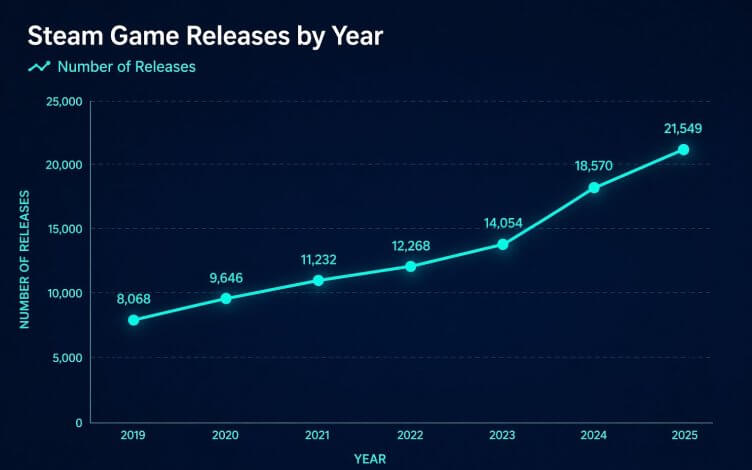
Steam Game Releases by Year
| Year | Number of Releases |
| 2019 | 8,068 |
| 2020 | 9,646 |
| 2021 | 11,232 |
| 2022 | 12,268 |
| 2023 | 14,054 |
| 2024 | 18,570 |
| 2025 | 21,549 |
The increase is steady, but what stands out is the pace. It’s not just more games each year – the number of releases is growing faster than it used to.
That doesn’t mean Steam represents the whole industry. Other PC platforms like Epic Games Store, GOG, and itch.io add their own share of titles, and mobile operates at a much larger scale. But Steam is one of the few places where the data is consistent enough to track how supply is changing over time.

How Fast Is the Number of Games Growing
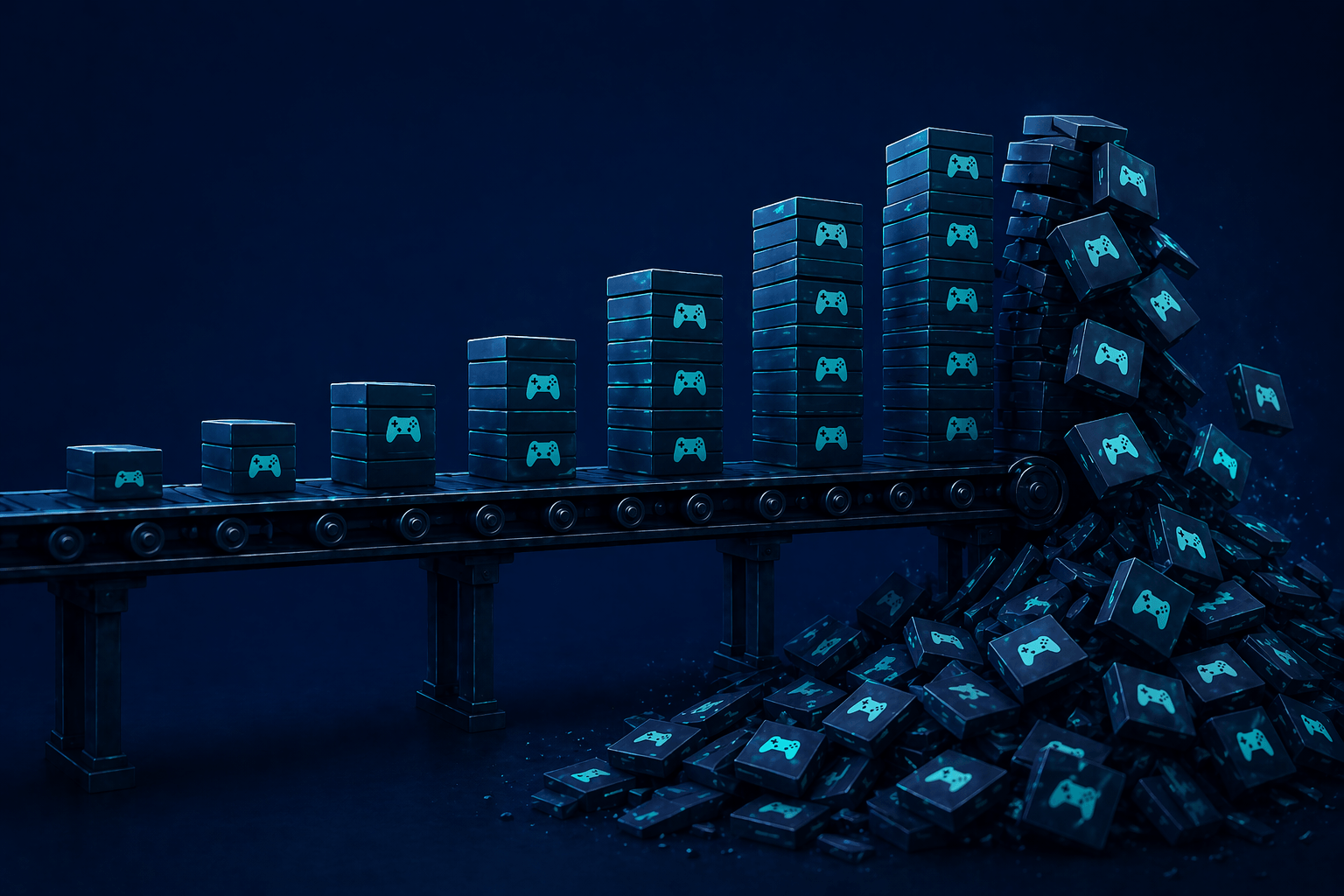
If you step back from individual years, the pattern is easy to see. The number of releases didn’t just go up – it started to stack faster over time. A few thousand per year used to be normal. Now it’s tens of thousands.
You can see it in the gaps between years. Early on, the increase is there, but it’s gradual. Later on, the increase between years becomes much more visible. The jump from 2023 to 2025 alone is larger than what used to take several years to build up.
That kind of change usually means the pipeline itself got wider. More teams are building games, and more of those projects are actually making it to release. Once that starts happening, the total number of games doesn’t just grow – it keeps accelerating.
How Many Games Exist in Total
There isn’t a clean number you can point to. No single place tracks everything, and the catalogs don’t line up across platforms.
On PC, you can at least see one side of it. Steam alone sits somewhere above 90,000 titles. That’s just one storefront, but it gives you a sense of scale.
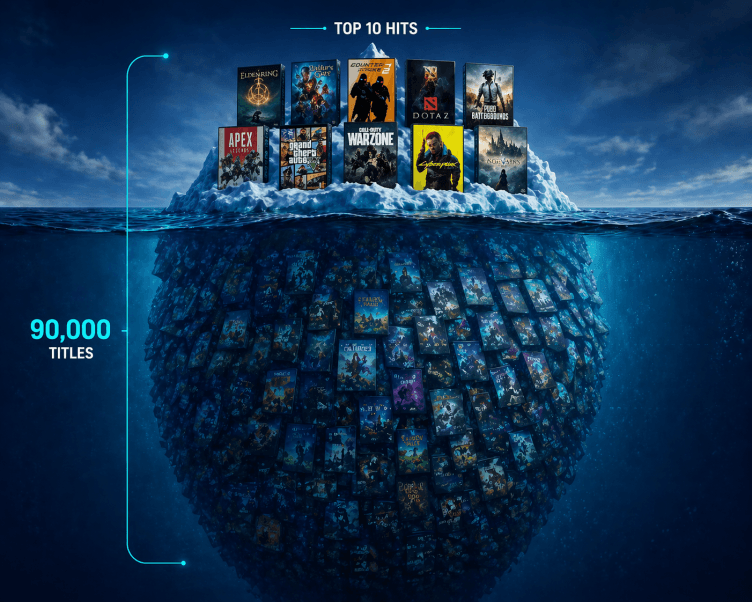
It doesn’t include everything else on PC, and it definitely doesn’t include mobile. Stores like Google Play and App Store operate at a completely different volume, where counting individual games stops being practical.
So instead of one total, you end up with separate pools. Tens of thousands on a single PC platform, far more on mobile, and no way to combine them into one reliable figure.
Why So Many Games Are Being Released
The biggest change is that making a game doesn’t require the same setup anymore. Work that used to require a full studio isn’t set up that way anymore. You can see it in how many small teams are shipping games now, sometimes just one or two people pushing something to release.
A big part of that is the advancement of tools. Game engines like Unity and Unreal Engine provide you with lots of support, so that you don’t have to start from scratch. You’re not spending months building core systems just to get started, so more of the effort goes into actually finishing something and getting it out.
Getting a game out is also more straightforward. Platforms like Steam don’t filter releases the way traditional publishing did. If a game is ready, it can be released.
As a result, more projects make it to that final step. Not all of them are large or commercially driven, but they still add to the overall count.
Early Access and Ongoing Releases
Not every “release” means the same thing anymore. Some games come out as complete products. Others appear earlier, before they’re really finished, and keep changing after release.
On Steam, both are treated the same in the data. A game released through Steam Early Access counts as a single entry, even if it stays in development for years after that. When that game leaves Early Access later, it doesn’t show up as a new one, thus not affecting the number. But there is a hidden factor.
Where it makes a difference is before that point. Early Access lets developers ship earlier, without waiting for a full version. Projects that might have stalled or stayed private now make it to release.
That doesn’t create duplicates, but it does increase the total. More games cross the finish line – even if that finish line looks different than it used to.
Breakdown by Platform
Separation by platform is very important. We can say “there are more games”, but to get reliable data, you have to think of each platform separately and understand what affects their numbers.
On PC, most of what you see comes through Steam. It’s not the only place games are published, but it’s where the volume is easiest to track, and where most projects end up anyway.
Mobile is a different story. There’s definitely more being released there, but the numbers are harder to pin down. A lot of games appear and fade out quickly, so even a higher total doesn’t give you a clear reference point.
Console sits on the other end. Fewer releases, more control, and a slower turnover. Not because fewer games are being made, but because fewer of them pass through that pipeline.
So instead of one global figure, you’re really looking at three separate systems that just happen to exist side by side.
Genre Distribution of Releases
If you look at what’s actually being released, a lot of games fall into the same few categories. You can see it just by browsing Steam for a while – certain tags keep repeating. Indie, Action, and Adventure show up across a large part of the catalog, and after that it’s mostly variations of the same mix – RPG, Casual, Simulation.
It doesn’t mean those genres dominate in revenue or player numbers. It just means a lot of projects end up being described that way. One game can carry several of these tags at once, so the categories blur together.
What you get is a kind of overlap where different games still land in the same buckets. That’s why some parts of the catalog feel much more crowded than others.
How Many Games Actually Get Noticed
Release counts don’t translate into attention. On Steam, volume keeps rising, but visibility is uneven.
Two signals from Valve’s own docs show where the bottleneck is. First, visibility is driven by storefront surfaces (featured capsules, recommendations, sales pages), not just being listed. Second, wishlists matter mainly because they convert into traffic at launch and during discounts, not because they directly boost ranking everywhere.
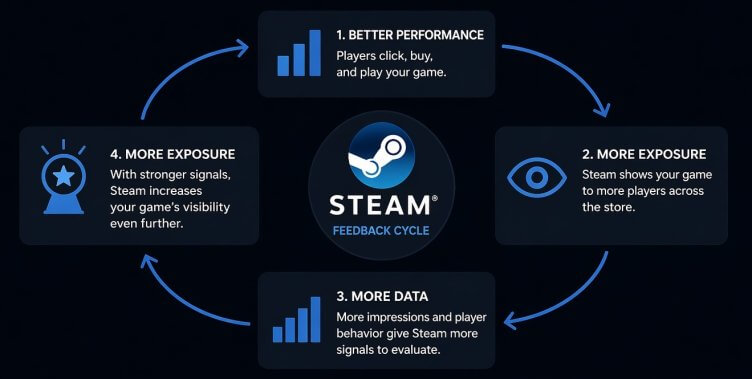
A practical rule of thumb you’ll hear from developers is that early performance sets the trajectory. If a game converts traffic well in the first days (click-through, purchases, retention), it keeps getting surfaced. If it doesn’t, it quickly drops out of those loops. Valve describes this as a feedback cycle:
There’s also a scale issue. Even if only a fraction of releases are competing for the same audience, that’s still thousands of titles per year. With that much inflow, most games won’t appear in charts or recommendations for long.
In other words, publishing is no longer the hard part. Getting into the storefront loops that actually drive traffic is.
Discoverability and Player Acquisition
Getting a game in front of players is where most of the difficulty sits now. The release itself is straightforward compared to what comes after.
On PC, discoverability is tied to how platforms surface games. On Steam, visibility comes from a mix of recommendation systems, featuring, and user behavior. Valve’s own guidance makes it clear that performance signals – clicks, conversions, playtime – feed directly into how often a game is shown. It’s not a fixed ranking; it’s a loop that reacts to how players interact with the game.
In practice, that means a game doesn’t just get shown because it exists. It gets shown if players respond to it. If those early signals are strong, the game appears more often. If not, it drops out of view quickly.
That feedback loop explains why release numbers and visibility don’t scale together. Even as more games are published, only a small share enters those loops and stays there.
Mobile runs into a different constraint. Instead of competing mostly through organic discovery, a large part of visibility comes from paid acquisition. According to AppsFlyer, global gaming user acquisition spend reached about $25 billion in 2025, which shows how much of the market depends on buying visibility rather than earning it.
That creates two separate pressures. On PC, the challenge is getting into recommendation loops early. On mobile, it’s being able to sustain acquisition costs. In both cases, the number of releases feeds directly into the problem – more games mean more competition for the same limited attention.
Comparison Over Time
If you look back far enough, the difference isn’t gradual – it’s a shift in how releases happen.
In the mid-2000s, most games still went through publishers and retail. That alone limited how many could come out each year. Imagine all the work publishers needed to do to get a game out there in the market? With limited resources, rocket-fast growth of the number of games wasn’t possible.
Then came the early 2010s. Just like with music, online publishing has allowed many artists to release their art without being chosen by big industry publishing companies. Digital storefronts are becoming more popular, and as you can imagine, selling a game online is much easier than getting it on a CD and distributing it in the real world. More small teams start shipping games, but the total is still relatively contained.
By the late 2010s, it looks different. Platforms like Steam stop acting as a real constraint, and the number of releases begins to grow much faster.
The 2020s just push that further. Once the constraints are gone, the total keeps rising – not because demand suddenly changed, but because more projects are able to make it all the way to release.
As Simon Carless, the author of GameDiscoverCo, once simply put it, “everyone should be lowering their sales and revenue expectation”. And if you’re not willing to keep your ambitions low, invest in marketing well before the release date.
What This Means for Developers
More releases doesn’t automatically mean more opportunity. It just means more competition for the same attention.
For developers, the main change is where the difficulty sits. Finishing a game is no longer the hardest part. Getting it seen is. With tens of thousands of releases each year, many games don’t get the attention they deserve.
That shifts how projects are approached. Marketing is no longer something that happens at the end. It has to be built into the process – from wishlists to community building to launch timing.
At the same time, expectations didn’t go down. Players still judge new releases against what they already play. That sets a baseline, even for smaller projects trying to break through. So while getting a game out is more straightforward now, getting it to stick is where the difficulty moved.
Revenue per Game: Reality Check
The total market size makes the industry look bigger than it feels at the individual game level. Global revenue is around $180–190 billion, depending on the year, which sounds like there’s plenty to go around. But once you break that number down across how many games are actually being released, the picture changes.
On PC alone, Steam sees 20,000+ new titles every year, and that doesn’t include mobile or console releases. The total supply of games is growing much faster than the total revenue. That gap is where most of the tension comes from.
Revenue is not distributed evenly. A small number of games capture a large share of spending, while the majority operate on much smaller numbers. You can see this in the same titles showing up year after year – games like Fortnite or Grand Theft Auto V continue to generate revenue long after release. New games aren’t just competing with each other, they’re competing with products that already have an established player base.
For most releases, the outcome looks different. Many games generate modest revenue or don’t scale beyond a small audience. That doesn’t necessarily mean they fail – some are built for niche communities or smaller goals – but it does mean the average result is much lower than what the total market size suggests.
This is why looking at total industry revenue can be misleading. That number mostly reflects what the top of the market is doing, not what a typical release looks like. Most of the money doesn’t spread across releases evenly. Relatively small number of games accounts for the most of it, while the rest make very little or nothing.
So even if total industry revenue keeps growing, that growth doesn’t really affect each average release in the same way.
What This Means for Players
For players, it mostly comes down to how much is coming out at once. There’s always a new release, often several, and it’s easy to lose track of what’s actually new versus what just surfaced again.
Most people don’t go through the full catalog. They see what’s put in front of them – store pages, recommendations, clips, or whatever is already circulating. That ends up shaping what gets played more than the total number of releases.
That’s why the same titles keep showing up. Once something gets traction, it stays in view, while most other games don’t really get a moment.
So even though the total number keeps rising, what players actually engage with doesn’t expand at the same pace.
Conclusion
The number of games coming out each year is much higher than it used to be, and that part is easy to measure. What changed more is how normal it became to release something. Projects that would have stopped earlier now make it all the way through.
That didn’t come with a matching increase in attention. Players didn’t suddenly start going through more games, and the way people find them didn’t expand much either.
So the gap isn’t between small studios and big ones. It’s between what gets released and what actually gets picked up.