
Outsourcing game art is extremely common, but what about animation? Is it better to be done within the same company that does the art, or is it enough just to hire a freelance animator? We’ll find answers to this and other questions in this article.
Why Studios Outsource 2D Animation
Remember those legendary images from the Disney studio in the 1930s when hundreds of painters were sitting shoulder by shoulder coloring images frame by frame to create famous Snow White or Mickey Mouse?

Copyright: © Disney Enterprises, Inc.
Over 750 people were doing this work for Snow White, which was released in 1937. Today, a similar animation film could be completed by a fraction of that workforce.
Yet animators have much more work today than they had in the past century. Animation is not only present in films, it is literally everywhere, and a large part of it belongs to video games.
The market of 2D games is growing steadily, and therefore, the demand for 2D art and animation does, as well. Especially in mobile games that gain huge revenues nowadays, 2D just feels right. Even big studios with hundreds of employees use 2D animation outsourcing, as the volume of animation at certain moments in development is too big to handle by an in-house team.
For smaller companies, animation is always a good thing to outsource since it’s not a part of so-called core game development – gameplay systems, engineering, level design, and so on. On the one hand, animation is essential to a game, but on the other hand, it’s not the thing that gets noticed first by players. Most outsourcing studios do 2D animation at a good level, and some do it at an exceptional level.
Another factor is animators’ specialization. Sometimes studios need a particular type, such as frame-by-frame animation, cutscene animation, or VFX, and they know that a 2D animation outsource studio will surely have people proficient in every style.
Last but not least, cost is always a major argument for outsourcing. You can find a qualified team overseas that will deliver the project for much cheaper than an in-house animator would. And for video games production, content is always a place where studios want to cut costs.

What’s Included in 2D Animation Services for Games
When producers request a quote for 2D animation, they often discover that “animation” is not a single service.
A game may need character movement, combat actions, UI transitions, spell effects, cutscenes, and dozens of other animated elements. Two projects can have the same number of characters but require completely different animation budgets depending on what those characters actually do in-game.
Gameplay Animation
The most substantial part of the animator’s work. It comprises all the movements of characters, heroes, and enemies – walk, attack, react, transitions between states. There are two main types of animation: skeletal (rigging) and frame-by-frame animation.
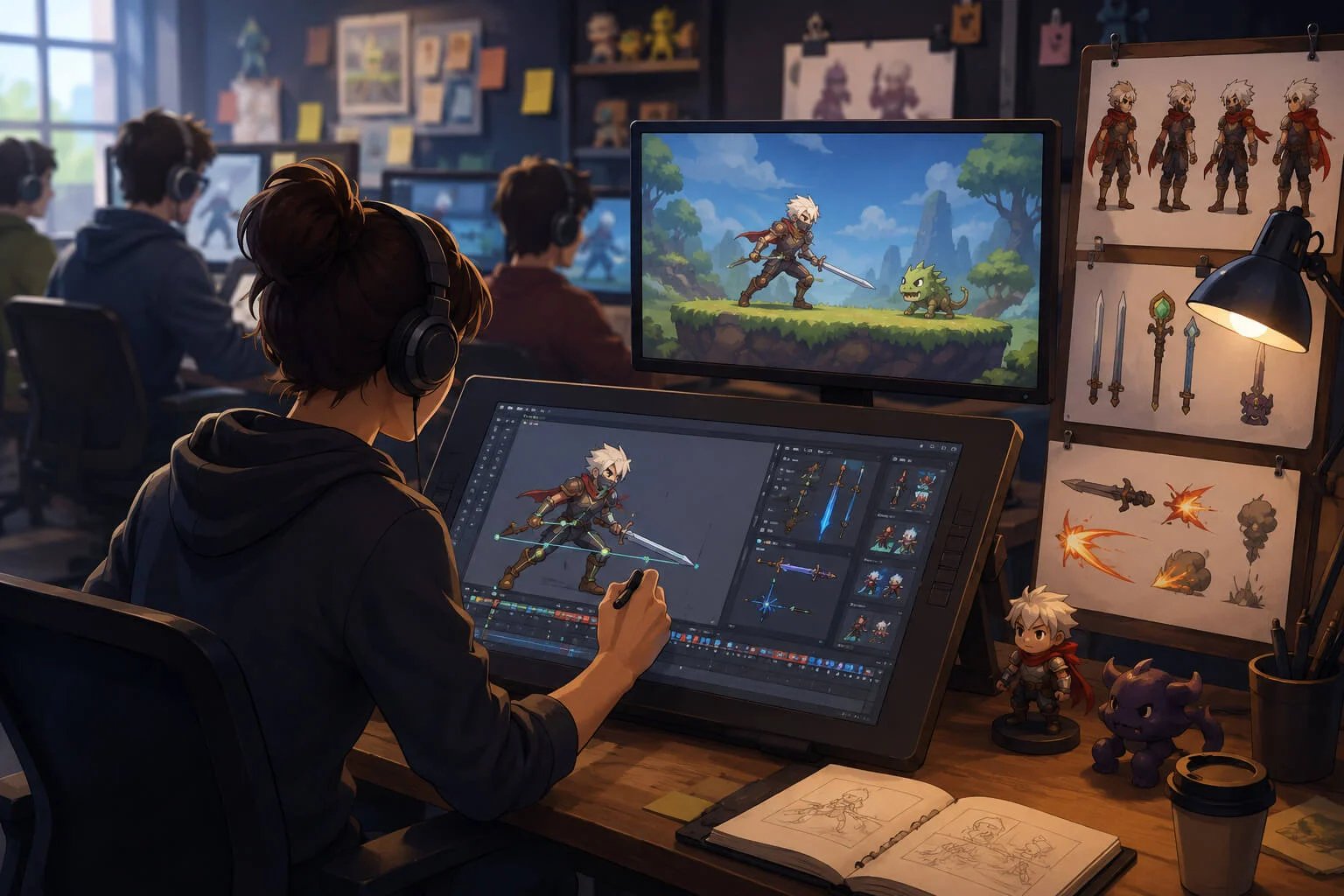
Skeletal animation means that the figures’ moves follow the structure of a rig that’s attached to the body, and individual body parts are moved using “bones”. Here is how this process looks in Spine, the most common software for skeletal animation.
This animation method allows making the animation process faster, cheaper, and more flexible to changes. For many studios, especially in mobile development, Spine animation has become the default approach to 2D animation production.
Not every game is a good fit for rigs. Some are still drawn with technology similar to the 30s’ Disney, where every movement is drawn individually. This approach is common in fighting games, premium indie titles, and games where visual style is a major selling point.
VFX, particle effects
Many of the most satisfying moments in games are not character animations at all.
Spell effects, explosions, projectile impacts, weapon trails, environmental effects, buffs, debuffs, and damage indicators all belong to the animation pipeline. In some projects, VFX production becomes a separate outsourcing stream because of the sheer amount of content required.
What is usually included depends on the scope. Basic combat effects, environmental effects, and ability animations are often part of a standard animation package. More complex systems, such as procedural effects, shader work, or engine-specific VFX implementation, may be estimated separately.
UI Animation
Players may spend hours looking at menus, inventories, reward screens, and progression systems. Without animation, these elements feel static. Small movements, transitions, button responses, and reward presentations help the interface feel responsive and polished.
Cutscenes and Narrative Animation
Gameplay animation and narrative animation, which help introduce characters, explain mechanics, or drive the narrative, work differently. Narrative animation can include simple dialogue scenes, tutorial sequences, event animations, or fully produced cinematics. Since it relies more on acting, timing, staging, and storytelling, studios often outsource it separately from gameplay animation.
Technical Preparation and Integration
Creating the animation itself is only part of the job. Animations must be exported correctly, integrated into the engine, connected to gameplay systems, optimized for performance, and tested across different devices and resolutions. Many top outsourcing studios support this stage as well because even great animation can create problems if it is not prepared properly for production.
This is why a request for “2D animation service” can mean very different things from one project to another. Some studios need a few character cycles. Others need an entire animation pipeline covering gameplay, UI, VFX, and narrative content.
Freelancer vs. 2D Animation Studio: What to Choose
The choice between a studio and a freelancer comes down to a set of factors that you can evaluate for your project individually.
| Criteria | Freelancer | 2D Animation Studio |
| Cost | Usually lower hourly rate | Higher upfront cost |
| Team Size | One person | Multiple specialists |
| Production Capacity | Limited | Can scale with project needs |
| Quality Control | Self-review | Internal review and art direction |
| Deadlines | Dependent on one person’s availability | Multiple resources available if schedules change |
| Pipeline Knowledge | Depends on the individual | Usually established production process |
| IP Protection | Varies by contractor | Typically covered by formal contracts and procedures |
| Bus Factor | High | Lower |
| Long-Term Support | Not always available | Usually available throughout production |
If a studio needs a few attack animations for a prototype, bringing in a freelancer usually makes sense. The communication is direct, there is little process overhead, and the budget stays small. The equation changes when production starts scaling.
A mobile game with 15 characters may easily require hundreds of animation states. Add VFX, UI motion, seasonal content, new skins, and live updates, and suddenly the challenge is not creating animations anymore. The challenge is delivering them consistently and on time.
Another thing producers learn quickly is that animation rarely arrives in one batch. There is almost always a second wave of work. A designer changes an ability. A new enemy gets added. Marketing requests an animated trailer. A publisher asks for additional polish.
When all animation depends on a single person, every change competes for the same schedule. This is one reason larger game teams often move toward studios even when freelancers are available. They are not necessarily buying better animation. They are buying production capacity.
There is also a practical consideration that does not appear in budgets. If an animator disappears halfway through development, the work does not stop being needed. Someone else has to pick it up, understand the files, learn the style, and continue production. For big projects, it can be quite a problem. Studios have workflows that help to manage that risk.
Key Criteria for Evaluating a 2D Animation Outsourcing Partner
Finding a studio that can animate is easy. Finding one that can fit into a game production pipeline is much harder.
Many teams realize this only after production starts. The portfolio looks great, communication seems smooth, but then the studio delivers files that are difficult to integrate, uses incompatible tools, or requires multiple rounds of rework because the process was never aligned with the project’s technical requirements.
Portfolio With Game-Specific Work
Not all animation portfolios are equally relevant. Great animation on the showreel doesn’t mean it will function as well inside a game engine.
When reviewing a portfolio, look beyond the final video. Ask to see actual game-ready assets, sprite sheets, Spine files, rigged characters, animation state machines, or examples already integrated into Unity or Unreal Engine. Apart from watching the files, read the case study and project description. What did the studio actually do in this project? How do they work, what were the challenges?
Tool and Engine Compatibility
Animation pipelines vary significantly between projects. Most production issues are not caused by bad animation. They happen when the animation pipeline and the development pipeline were never aligned.
Before starting production, make sure the studio works with the same tools, export formats, and integration process that the team plans to use throughout development. A project with a well-established Unity pipeline may have very different nuances than a game targeting Unreal Engine.
This is worth clarifying early. Rebuilding assets because of pipeline incompatibilities is rarely a pleasant surprise.
Communication Process and Revision Policy
Animation is an iterative process. No matter how detailed the brief is, feedback and revisions will happen. The important question is how the studio manages them.
Some teams work milestone by milestone, approving, blocking, key poses, and polishing separately. Others deliver complete animations for review. Whatever your favorite mode of collaboration is, make sure it is discussed beforehand and documented in the agreements.
Here are key points that need to be defined:
- Who will be the main point of contact?
- How is feedback collected?
- How many revision rounds are included?
- Is there any time zone difference that requires a special communications arrangement?
File Delivery Standards
The final deliverable is not the animation itself. It is the package that the development team receives.
Different studios deliver different things. Some provide only exported files, while others also give things like source files, rig setups, naming conventions, documentation, integration instructions, and so on. You may not necessarily need all of those, but possible deliverables have to be defined before the start, such as:
- Source files or exports only
- Spine, DragonBones, or project files
- Sprite sheets and texture atlases
- Rig documentation
- Naming conventions
- Engine-ready assets
- Integration support
A smooth delivery process makes the work of developers a lot easier.
Red Flags When You Outsource 2D Animation Services
Most outsourcing problems become visible long before the first deadline is missed. The warning signs usually appear during the first calls, portfolio reviews, and estimation discussions. The challenge is that they are easy to ignore when the rates look attractive and the artwork looks good.
A Portfolio That Looks Good but Contains No Game Work
Animation for games has very different requirements than animation for advertising, social media, or explainer videos. A studio may have a great animation proficiency but struggle with game animation simply because they’re not familiar with the pipeline.
No Milestone Plan
Animation almost never gets approved in one go. Characters need tweaks. Designers change abilities. Timing gets adjusted. New requirements appear halfway through production.
Most experienced studios build approval points into production, and all the details, milestones, reviews, and micro deadlines are mentioned in the work plan.
Revision Terms Are Vague
Revisions are a normal part of animation production. The problem appears when nobody defines what is included. How many review rounds are part of the estimate? What happens if gameplay changes after the animation starts? How are additional requests handled?
If revision policies are unclear during negotiations, they tend to become expensive during production.
Nobody Asks About the Game Engine
One of the easiest ways to spot a studio that mostly works outside of game development is the complete lack of technical questions.
Sooner or later, animation has to end up inside Unity, Unreal Engine, Godot, or a custom engine. It has to work with gameplay systems, fit performance budgets, and follow the project’s technical constraints.
Studios that regularly work on games tend to ask about those things almost immediately. If the discussion reaches the estimation stage and nobody has asked how the assets will be implemented, there is a good chance those questions will appear much later, when changing the approach becomes expensive.
The Studio Talks About Art but Not Production
Almost every studio can show impressive animation examples. The more useful conversation is usually about what happens after the animation is approved.
How will feedback be handled? Who reviews the work? What files will be delivered? What happens if the design changes halfway through production? How quickly can additional content be produced if the scope grows?
Teams that have been through game production before usually spend as much time discussing the process as they do discussing the artwork itself. They know that delays rarely happen because an animator cannot animate. They happen because approvals, revisions, communication, and delivery expectations were never clearly defined.
A beautiful portfolio can win a pitch. A reliable production process is what gets a project shipped.
How to Prepare for Outsourcing: What to Give Your Partner
A surprising number of outsourcing problems start before production even begins. Studios are often asked to estimate animation work based on a few character images and a short description of the game. The more information they get before the start, the better the final result will be.
Art Bible and Style References
One studio may animate a sword attack as a quick, arcade-style slash. Another may treat the same attack as a heavy, realistic movement. One creative task can be solved in a hundred different ways.
If the creative team and the client imagine it differently, even the greatest art won’t work. The solution to this problem is art bibles and references. They include character sheets, color palettes, examples from similar games, mood boards, gameplay videos, or even rough sketches.
People who haven’t worked with animation much may think that there’s less possible creative choices with animation, but there are just as many options. That’s why animation references are especially valuable – because movement is often much harder to describe than it is to show.
Technical Specifications
And then of course, everything can go wrong if the files formats are not the ones developers needed.
A character animated at 60 FPS may not fit a game built around 12 FPS animations. Sprite dimensions, atlas structure, export formats, engine requirements, naming conventions, and target platforms all affect how animation should be produced. All the specs have to be documented as early as possible and as detailed as possible.
Scope and Timeline Documentation
Animation estimates are only as accurate as the scope behind them. A character with four animation states is very different from a character with twenty. A game with five enemies is very different from a game with fifty. At a minimum, it helps to define:
- Number of characters
- Number of enemies
- Animation states per asset
- Required VFX
- Cutscenes or narrative sequences
- Delivery priorities
- Production milestones
Many studios also split animation work into batches. Core gameplay animations are delivered first, while secondary content follows later. It allows to save time and reduce the volume of work that has to be done after revision.
Workflow: How 2D Animation Outsourcing Typically Works
Animation production can be quite different in different studios. Here is how we do it at Kevuru Games.
Step 1. The Brief
The first conversation is rarely about animation itself. It is usually about the game. Who is the character? What actions does it perform? Is the animation intended for gameplay, UI, or a cutscene? Which engine is being used? The more answers available at this stage, the fewer assumptions everyone has to make later.
Step 2. Key Poses
Nobody starts with a polished animation. Animators usually block out the movement first by creating key poses or a rough version of the animation. This is where timing, weight, proportions, and overall feel are approved. Changing direction here is relatively easy. Changing it after the animation is finished usually is not.
Step 3. Approval
Once the movement feels right, the client signs it off and production continues. This is also where projects can slow down, and time for review and approval has to be planned for in the overall schedule.
Step 4. Animation Production
Only after the direction is approved does the full production begin. This is where in-between frames, polish, secondary motion, loops, transitions, and any additional animation states are completed. If the project includes VFX or UI animation, they are often produced in parallel.
Step 5. Technical Delivery
Before anything reaches the game, the studio prepares a production-ready package. As mentioned before, the list of the deliverables and files format have to be agreed on beforehand. It may include sprite sheets, Spine projects, source files, texture atlases, naming documentation, and export settings.
Step 6. Integration
The final check happens inside the game itself. An animation can look perfect in Spine or Adobe Animate and still require small adjustments once connected to gameplay. Movement speed may feel wrong. Transitions may need tweaking. Hit timing may need to change. The general rule is that the last review and edits have to happen after in-engine integration.
Pricing Factors for 2D Animation Services
There is no such thing as a standard price for 2D animation. A studio may ask for the same character and receive two completely different estimates depending on what that character is expected to do. The artwork itself is only the starting point. Most of the production time is spent on movement.
Animation Technique
As explained in previous blocks, different animation methods are more labor and time consuming than others. Frame-by-frame animation requires every pose to be drawn by hand, which takes longer to produce than skeletal animation, where after a rig is ready, further animations can be done much faster.
Number of Animation States
Studios rarely estimate animation per character. Characters can have very different “screen time”. There are NPC that only walk around, and then there are characters who run, jump, fight, cast spells, cook dinner, clean the table, and so on. To count the volume of work (and therefore the price) correctly, animation states must be counted.
Rig Complexity
Before a character moves, somebody has to build the rig.
A simple cartoon character can often be prepared quickly. A character with layered clothing, long hair, weapons, facial expressions, or secondary motion requires considerably more setup before animation even starts. That extra preparation becomes part of the estimate.
Revisions
Very few animation projects make it from the first sketch to the final delivery without changes. Sometimes the feedback is minor: adjust the timing, make a jump feel heavier, or exaggerate an attack. Sometimes a game designer changes an ability halfway through production, and the animation has to be reworked completely. More revision rounds mean more working time and higher overall project price.
Technical Requirements
There is a difference between finishing an animation and delivering it. Once the creative work is done, animators have to do the technical part: exporting files, preparing sprite sheets or Spine projects, organizing atlases, following naming conventions, and making sure everything works in the engine all take time.
It’s the kind of work players never see, but developers certainly do. Two animations may look almost identical in the final game, yet require very different amounts of technical preparation behind the scenes.
That is why animation estimates are built around the entire production process, not just the animation itself. If you are calculating the cost for your game development, make sure to check out our formula for calculatiing 2D and 3D art cost.
What Makes a Reliable 2D Animation Outsourcing Partner
Finding a studio that can produce good-looking animation is not particularly difficult. Finding one that fits naturally into a game development pipeline is much harder.
By this stage, the evaluation comes down to four questions.
Does the studio have experience with games similar to yours? A portfolio filled with game-ready assets, released titles, and projects using the same animation techniques is often a better indicator than an impressive showreel.
Is the production process transparent? Clear milestones, regular reviews, predictable communication, and well-defined revision rounds make it much easier to keep a project on schedule.
Can the team work with your pipeline? Animation should arrive ready for production, not create extra work for developers. Compatibility with your engine, animation tools, and technical requirements is just as important as artistic quality.
Finally, has the studio shipped real games? Check their projects and case studies along with showreels.
And if you’re looking for an advice on how to outsource game art and animation, contact us! We’ll go through your project together, help define the scope, identify the right production approach, and prepare an estimate that reflects the actual amount of work – before production begins.