
This article starts with a direct answer to the question it poses, but don’t close it right away – there’s a lot more to know about gamers audience statistics than just one number. Estimates for 2026 usually land somewhere around 3.4 to 3.6 billion people worldwide. It sounds impressive, although the scale stopped being the main story a while ago – once you’re counting in billions, the difference between them is less important than how those players are actually distributed.
What actually matters is what sits behind that number. Players are spread across regions, devices, and habits that don’t really overlap that much. Someone playing on a phone in Southeast Asia and someone spending evenings on a console in the US are both counted the same way, even though their behavior – and value for a game – can be completely different.
The definition of a “gamer” has also stretched quite a bit over time. It’s not just people who follow releases or spend hours in games. It includes anyone who plays from time to time, even casually. That shift alone explains a big part of the growth over the last decade, especially with mobile pulling in a much wider audience. Newzoo is one of the sources that regularly updates these estimates and explains how the audience is counted.
How many gamers are there in 2026
If you look for a single number, you’ll find a range instead. Most estimates for 2026 land somewhere around 3.4 to 3.6 billion people who play games in one form or another. The gap comes from how “playing” is defined. A few minutes on mobile once in a while may count in one dataset and not in another.
The direction is clearer than the exact figure. Growth didn’t stop. It just doesn’t stand out the same way anymore.
If you look back at 2020, the jump is hard to miss. After that, the line keeps going up, but more quietly. No sharp turns, no sudden jumps – just steady movement that’s easy to overlook if you only check the latest number.
Because of that, the total on its own can be a bit misleading. It looks like one clean figure, but behind it, the audience hasn’t been growing in a uniform way.
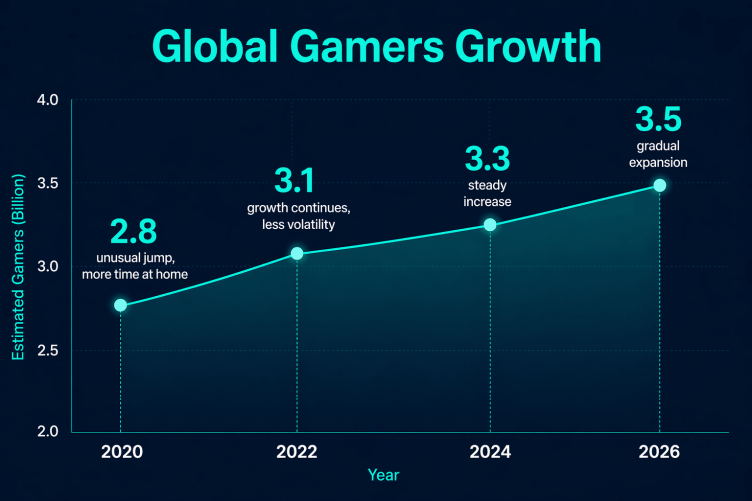
| Year | Estimated gamers (billion) | Context |
| 2020 | ~2.8 | unusual jump, more time at home |
| 2022 | ~3.1 | growth continues, less volatility |
| 2024 | ~3.3 | steady increase |
| 2026 | ~3.5 | gradual expansion |
These figures come from aggregated industry estimates and public summaries. They don’t match perfectly, but they tend to stay within the same band.
There is also a simple constraint behind all of this. The audience grows alongside internet access. As more people get online, more people can play, but once large regions are already connected, the pace naturally slows down.
Another detail that complicates the picture – players don’t sit in one bucket. It’s common to move between mobile, PC, and console depending on context. Because of that, platform totals often overlap and can’t be summed into a clean global number.
At this point, the scale is already large enough that small changes in the total don’t change much. The differences that matter show up when you start breaking the audience down further.
Gamers by platform
The total number doesn’t split neatly by platform, mostly because people don’t stick to just one. It’s common to play on a phone during the day and switch to PC or console later, so any breakdown here overlaps by default.
Mobile still takes the largest share by a wide margin. It’s the most accessible entry point – no extra hardware, shorter sessions, lower barrier overall. In practice, this is where most new players come from, especially in regions where consoles or gaming PCs are less common.
PC sits in a different position. The audience is smaller than mobile, but more concentrated around specific genres – competitive games, strategy, MMOs. Session time is usually longer, and players tend to stay within the same titles for extended periods.
Console is more stable than it looks from the outside. The audience doesn’t grow as fast, but engagement and spending per player are typically higher. Releases are more structured, and the experience is more controlled compared to other platforms.
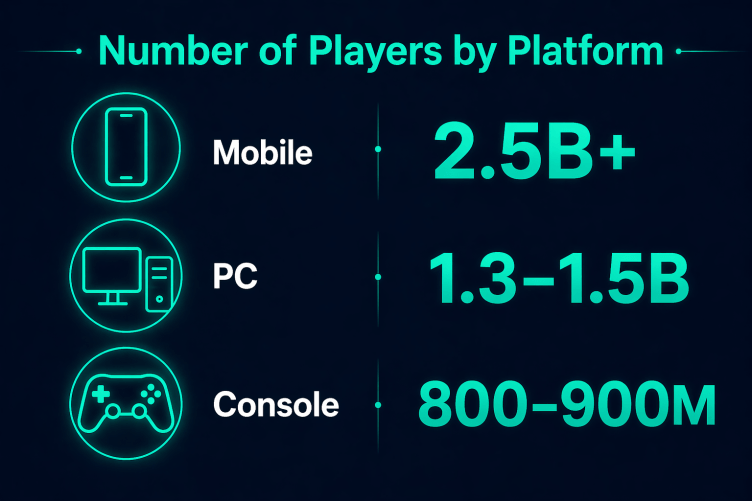
If you look at rough scale, the distribution tends to fall into a pattern like this:
| Platform | Estimated players |
| Mobile | 2.5B+ |
| PC | 1.3–1.5B |
| Console | ~800–900M |
These ranges vary depending on how overlap is handled, but the overall ratio stays similar.
One thing that changed over time is how strongly these segments connect. Cross-platform play comes up in a lot of games now. In Fortnite or Call of Duty: Warzone, the platform matters less than it used to. You’re basically in the same game either way.
That shift affects design decisions directly. Interfaces, performance targets, and even art pipelines have to account for multiple platforms from the start, not as an afterthought.
Regional distribution of gamers
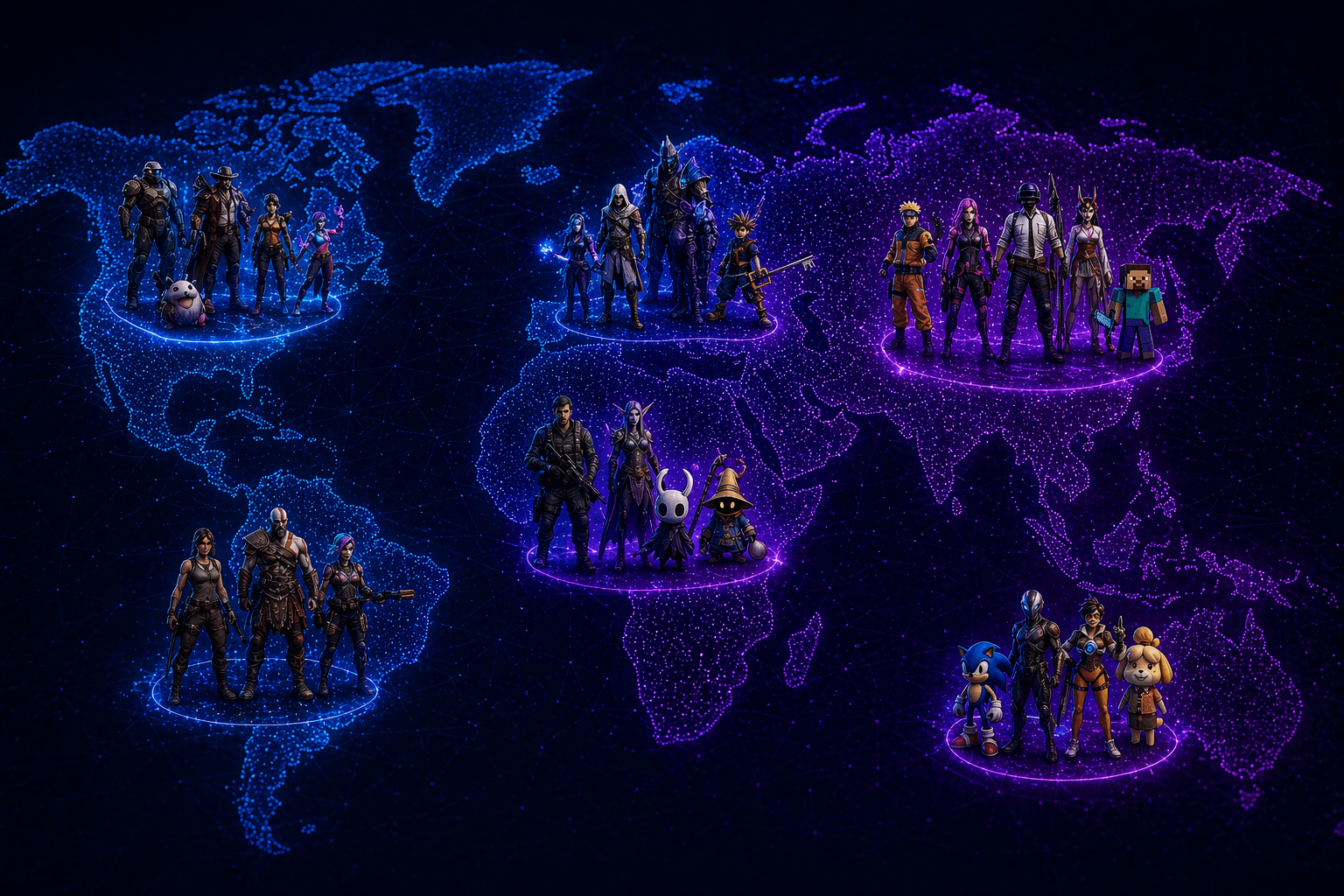
The global number looks big, but it’s not evenly spread. Most of it sits in one place.
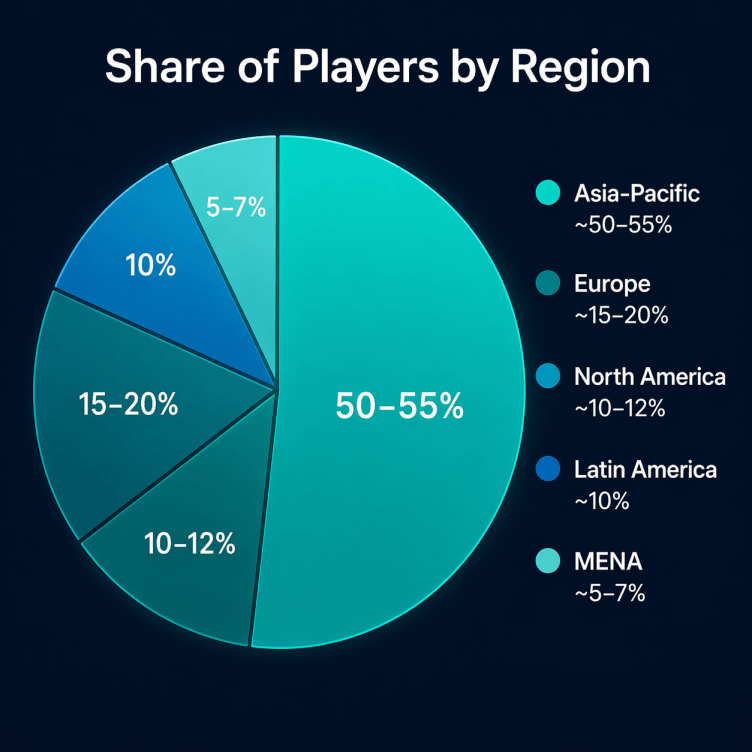
Asia takes up a large part of the audience – roughly half, sometimes more depending on how it’s counted. That’s mostly because of scale. Countries like China and India alone shift the balance, and mobile plays a big role there. For a lot of players, that’s the main way into games.
Europe and North America feel different in comparison. Fewer players overall, but higher spending and more overlap between PC and console. Growth there isn’t really about new users anymore. It’s more about how people play and what they spend on.
Then there are regions that don’t stand out in total numbers yet, but keep coming up in discussions. Latin America, parts of the Middle East and North Africa. The audience there is still expanding, and a lot of that comes down to access – better internet, more smartphones. It doesn’t happen all at once, but you can see the shift over time.
| Region | Share of players |
| Asia-Pacific | ~50–55% |
| Europe | ~15–20% |
| North America | ~10–12% |
| Latin America | ~10% |
| MENA | ~5–7% |
The exact numbers move a bit depending on the source. The overall picture, though, tends to stay roughly the same.
What matters here is not only where players are. Once you start looking closer, the differences between regions show up pretty quickly.
Age distribution of gamers
“Teenagers” is still the default image, but it doesn’t really line up with how the audience looks now. You still see it in some genres, just not across the whole market.
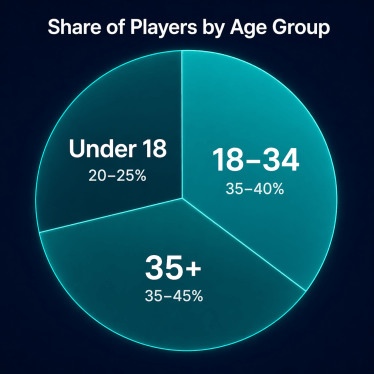
A lot of players are in their 20s and 30s. Not always the same habits as before. Some play less often, some just pick a few games and stay with them.
There’s also a noticeable chunk of 35+ players. Easy to miss if you only look at competitive titles. Shows up more clearly on mobile.
Younger players are still there. They just don’t dominate the same way. Time is spread across different things, and a lot of it goes into platforms like Roblox or Fortnite.
| Age group | Share of players |
| Under 18 | ~20–25% |
| 18–34 | ~35–40% |
| 35+ | ~35–45% |
The split moves depending on the source, but the direction doesn’t change much. The audience isn’t getting younger.
Gender distribution
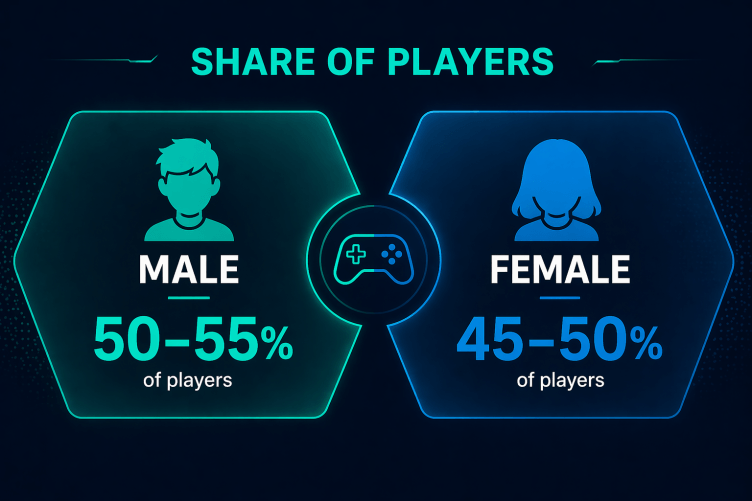
The split isn’t as one-sided as it used to be. Depending on the platform, it gets pretty close to even.
On mobile, it’s often near a 50–50 split. Sometimes slightly skewed, but not by much. A lot of that comes from the type of games and how easy they are to access. You don’t need much setup, so the audience ends up being broader by default.
PC and console look a bit different. Some genres still lean heavily male – competitive shooters, certain strategy titles. Others don’t follow that pattern as closely. It depends more on the game than on the platform as a whole.
There’s also a difference in how people play. Session length, preferred genres, spending habits – those vary, but not in a way that fits into a simple split. It’s less about gender as a category and more about patterns that show up across different groups.
| Group | Share of players |
| Male | ~50–55% |
| Female | ~45–50% |
The difference between them is still there. Just not as pronounced as it used to be.The split looks closer now if you compare it over time.
Time spent and engagement
Time in games didn’t grow in a straight line either. There was a visible jump around 2020, then things settled. Since then, the totals move, just more slowly.
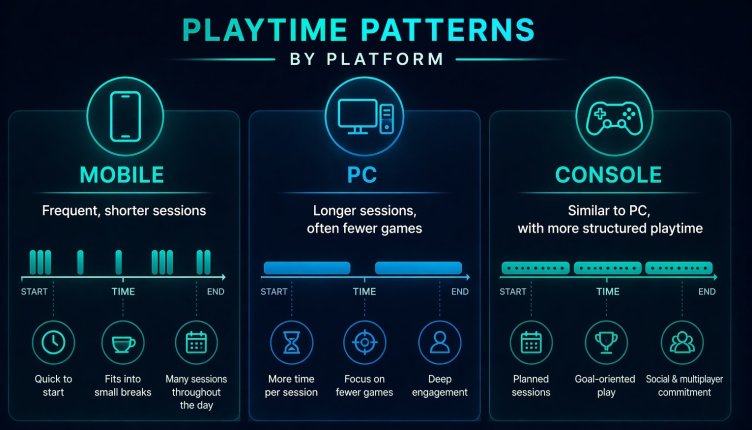
How that time is distributed depends a lot on the platform. Mobile tends to break into short sessions – a few minutes here and there, repeated during the day. PC and console look different. Fewer sessions, but longer ones, often tied to specific titles rather than constant switching.
There’s also a difference between “installed” and “played.” A lot of games get downloaded and never opened again, especially on mobile. The active part of the audience is smaller, and it concentrates around a limited number of titles.
You can see that in how engagement clusters. A relatively small group of games ends up taking most of the playtime. The rest are there, just with much less attention.
You can see it in games like Genshin Impact or Fortnite. They stay active for long stretches. Not really because of the initial release, more because there’s always something new being added.
One detail that comes up often is retention. Getting players to install a game is one step. Keeping them coming back over time is where most of the competition happens.
Spending behavior
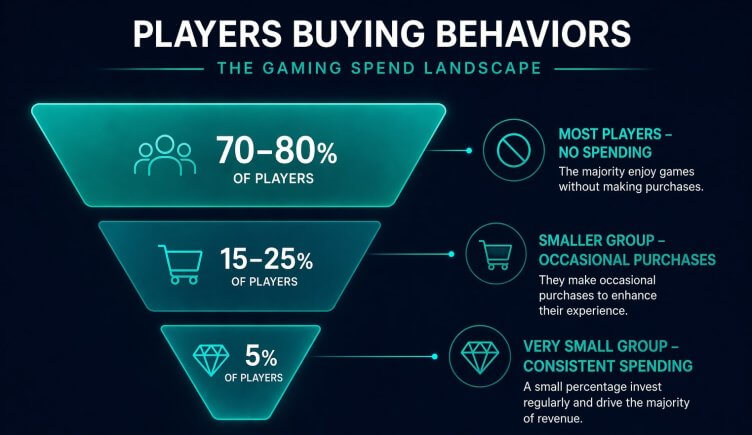
The number of players and the number of paying users are not the same thing. Most people don’t spend at all. They still play, sometimes regularly, just without making purchases.
Revenue tends to concentrate in a smaller part of the audience. Not evenly spread. A limited share of players accounts for most of the spending, especially in free-to-play games.
Mobile makes this more visible. It has the largest audience, but also a very wide gap between players who pay and those who don’t. On PC and console, the structure looks different. Fewer players overall, but a higher chance that they spend something, even if it’s just the initial purchase.
There’s also a difference in how spending happens. One-time purchases still exist, mostly on PC and console, but a lot of revenue now comes from ongoing transactions – skins, battle passes, expansions. Not large individually, but repeated over time.
That pattern shows up across platforms, even if the proportions change. The main shift here is not just how much players spend, but how often and in what form.
What “gamer” means in 2026
The label itself got broader, and it’s not very precise now. A person who plays a few minutes on mobile during the week and someone who spends hours on a competitive PC game both fall under it. Those cases don’t really match, but they’re still counted together.
A lot of people move between those modes. Quick sessions during the day, longer ones later. Not always on the same device, not always in the same genre. It depends on context more than on a fixed preference.
You can see that mix in how different types of games sit next to each other now. Platforms like Roblox or Fortnite don’t really separate playing from social interaction or content creation. It all overlaps. More traditional formats are still there as well. Single-player releases, competitive multiplayer, longer RPGs – they didn’t go away, they just exist alongside that.
Because of that, segments like “casual” and “core” don’t separate the audience cleanly. They still describe behavior, but not identity. The same player can move between them without really noticing.
Another shift is how fragmented attention is. Players don’t necessarily stay within one game or one platform. They rotate, come back, drop off, then return again if something changes. Content updates, events, social pull – those tend to matter more than initial release timing.
The definition ends up being functional rather than strict. A “gamer” is anyone who plays, but what that actually looks like can vary quite a bit from one person to another.
Conclusion. What this means for game development
All of this shows up in production decisions, not just in reports. The audience is larger, but also less uniform, so one-size assumptions don’t hold for long.
Targeting gets more specific. Region, device, session length – those change how a game is designed and how content is delivered. What works for a mobile audience in Southeast Asia won’t translate directly to a console audience in North America.
Content volume becomes a factor as well. Games that keep attention over time tend to update regularly. That affects pipelines more than anything else. Art, design, engineering – all of it has to support ongoing changes now. Not just something that ships once.
Then there’s consistency across platforms. A game running on mobile, PC, and console still has to hold together. The assets don’t have to match exactly, but the behavior and overall style usually do.
Localization comes up earlier in the process. Not only language, but cultural context, UI expectations, monetization patterns. Small differences at that level can affect retention more than large feature changes.
If you reduce it to a few practical points:
- define the target region early
- decide on platform priorities before production scales
- plan for ongoing content, not just launch
- keep visual and technical consistency across devices
- account for localization beyond translation
None of this is new on its own. What changed is how often these constraints appear together in the same project.
![2D and 3D Art Cost: Universal Formula for a Quick Estimate [+Built-in Instant Price Calculator]](https://kevurugames.com/wp-content/uploads/2023/04/4-752x301.webp "2D and 3D Art Cost: Universal Formula for a Quick Estimate [+Built-in Instant Price Calculator]")