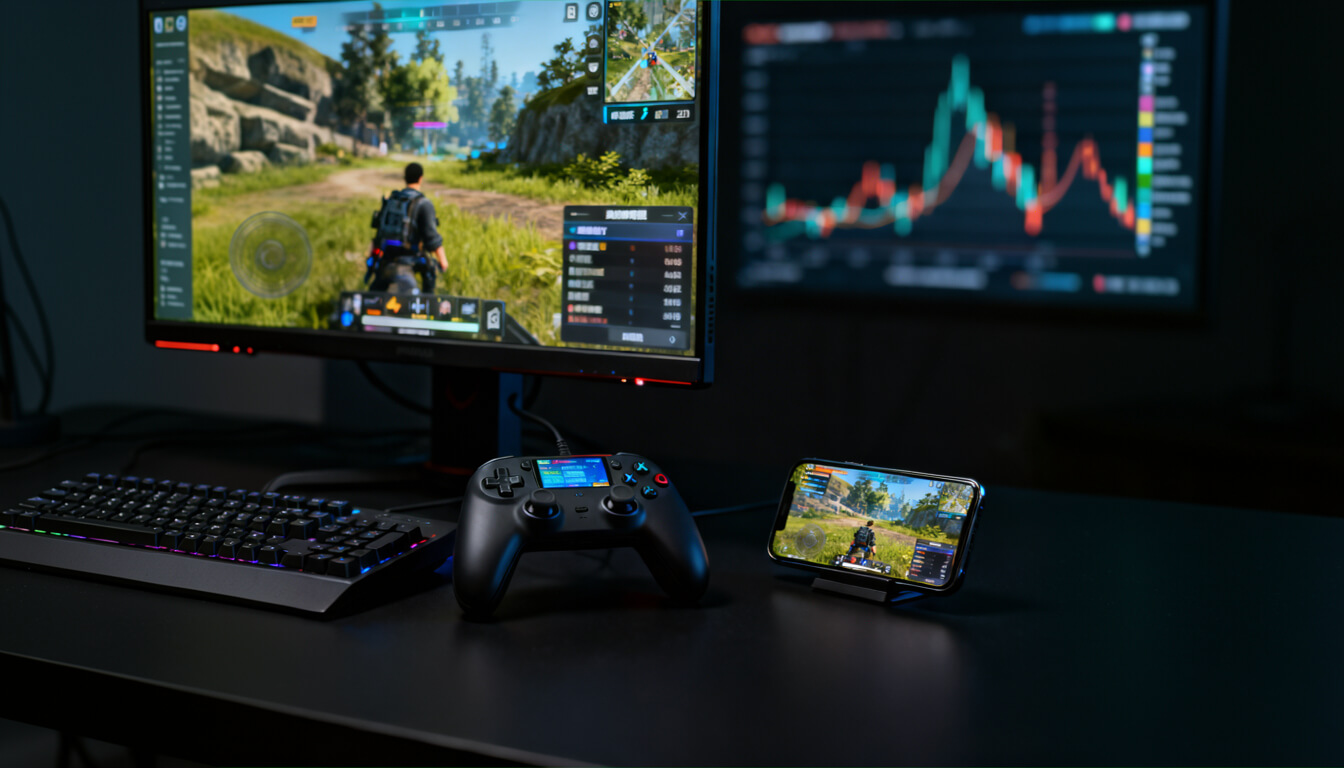
In the gaming world, technology remains the primary driver. It contributes to the high-fidelity graphics and realistic environments, as well as the spatial experience.
When it comes to choice, players have several options: PCs, consoles, and mobile devices. A good number of games are available across these hardware sectors, but a few are siloed in one or two. With the market currently estimated at over $280 billion, the tug-of-war is getting even harder.
So, what platform accepts what games? How do each compete against others? Let’s look at the mobile vs. PC vs. console games market today and the stats that matter.
The Trends in the Global Arena
The gaming market enjoyed double-digit improvement as COVID-19 devastated the world. Around 2020, its year-on-year growth was a whopping 24.2%. It expanded by 26% between 2019 and 2021. This explosive expansion did not go beyond the pandemic. Years down the line, the market has largely matured. For instance, it is projected to grow between 4.6% and 6.5% in 2026.
What other things could be driving the market growth? Let’s explore three of the factors below.
Mobile Adoption in Emerging Markets
The biggest determinant in the market is not the hardcore gamer who buys titles for nearly $100. Instead, it is a smartphone owner who would love to try the latest mobile game. So, the portable device becomes the primary computing hardware for new games. Besides, as 5G infrastructure matures in these territories, millions of new players are entering the ecosystem every month, bypassing the “console era” entirely.
The Live-Service Dominance
In the 2010s, the success of the games was ‘hit-driven.’ This means that the success of the title was determined by the launch week’s sales. However, this has changed. It is now measured by the average revenue per daily active user (ARPDAU) over a period. The live service games receive regular monetization events and updates, and are the most common in the market. Today, they account for over 70% of the software revenue across all platforms.
In-Game Purchases Have Revolutionized Revenue Generation
Monetization has moved from just loot boxes and new user subscriptions to more digital identity items. Battle passes have also gained traction in the marketplace. You will find that customers are willing to spend small amounts (usually under $20) to customize their digital presence. This scales perfectly for mobile devices, but other hardware options are catching up.
Mobile Gaming: The 55% Empire
Mobile gaming is the undisputed titan of gaming. It holds about 55% of the total market share and generates more revenue than PCs and consoles combined. Over 3.6 billion players use mobile devices for gaming. This market has slowed down to 4.4 YoY in 2025, a clear marker that the market is maturing.
How did the Mobile Gaming Lead?
To understand how we reached this point, we have to look at the structural advantages that mobile possesses over its “tethered” rivals.
The Zero-Barrier Entry Point
Users do not need to buy extra hardware to play games. A gaming PC or a console is an “extra” purchase. It is a luxury item that serves one primary purpose. A smartphone, conversely, is a life necessity. By turning a tool that everyone already owns into a gaming machine, developers have tapped into a player base of 3 billion people.
This has fundamentally changed the “barrier to entry.” For a console player, the cost of entry is $500 (hardware) + $70 (one game). For a mobile player, the cost of entry is $0. This “Free-to-Play” (F2P) model is the reason mobile earns over $100 billion annually.
The Snackable Content Upgrade
Today, human attention spans are more fragmented than they have ever been. People get a few minutes for gaming amidst work, travel, and study unless they are dedicated gamers. An average play session lasts between 5 and 8 minutes. This is the strength of the mobile games. You can open a game when you have a few minutes to spare and hit a milestone before your next activity. This is partly the reason most people would try mobile gaming more than tethered hardware.
Native Social and “LiveOps” Integration
On mobile, inviting a friend, sharing a screenshot with a group chat, or responding to a guild notification is instantaneous. On traditional platforms, these actions often require headsets, separate menus, or leaving the game environment.
How Do Mobile Games Get Revenue?
Mobile monetization is a long-tail form. This means that players buy small items over a period. It is estimated that over 85% of the mobile revenue comes from in-game purchases. This inflow can be traced to three streams:
Consumables: Include extra lives, time savers, and energy refills. These are usually cheap purchases that appeal to casual players
Collection and Gacha: These are item and character collections for midcore to hardcore players. Such items cost a little more but appeal to players who have already pledged loyalty to the title.
Advertising: Some players do not spend cash on games or related items. Companies monetize them via rewarded video ads. Here, users watch ads for rewards. They are non-intrusive and monetize them without asking for a coin from them.
Console Gaming: The Fortress of “Premium” Tradition
Console gaming is the second-highest market by size, expected to take a respectable 25% to 30% market share in 2026. It is expected to bring in $45.9 billion and grow by 5.5% (YoY). This growth has largely been driven by the launch of the Nintendo Switch 2, higher software prices, and a stronger release calendar. If combined with the PC share, these two sectors will bring $85.8 billion (which is 45% of the total customer base)
People buy consoles for prestige. They may own a PC and play on mobile devices, but they will buy the dedicated hardware for assets. Here are important things to note about this sector of the gaming market.
The “It Just Works” Value Proposition
Despite the rise of complex PCs, the console survives on simplicity. Interestingly, the average consumer still values a device that plugs into a 4K television. Consoles provide a level of optimization that PCs cannot match for the same price point.
For example, a $500 console in 2026 still offers a more consistent 4K/60fps experience than a $500 PC could ever dream of, thanks to fixed-hardware development.
The Power of the “First-Party” Moat
The console market is sustained by exclusives. Brands like Sony, Nintendo, and Microsoft lean heavily into their internal studios. This has created a cultural conversation dominated by blockbuster console launches. The games they put on this hardware are “system sellers,” as they sell everything as a package.
Over 600 million users play on consoles. For them, the ability to take part in the latest Zelda, God of War, or Halo title is worth the price of entry into a closed ecosystem.
The Challenges of a Slow Cycle
The primary threat to the console in 2026 is its own upgrade cycle. We are currently in the mid-to-late stage of the hardware generation. The “new car smell” of the current machines has faded, and the next leap in technology is still years away. This has led to a stabilization of hardware sales. Furthermore, consoles are facing “The Great Squeeze”:
- From Below: High-end mobile phones can now run “triple-A” ports of console games.
- From Above: High-end PC hardware has significantly outpaced console performance, making the $600 “box” look dated to enthusiasts.
PC Gaming: High Utility Sector
PC gaming currently sits in third place by revenue, holding roughly 20% to 23% of the market share. It is expected to generate about $96 billion in 2026, up from $86.12 billion in 2025.
The increase has been driven by annual hardware upgrade cycles, which have expanded player bases in Asia and increased engagements on platforms like Steam. Today, it has about 936 million active players (about 26% of all gaming players).
PC gaming includes both software and hardware. The software alone generated over $39.9 billion in 2025, while hardware earned $70.85 billion. Peripherals brought in some $9.15 billion.
What Are the Strong Advantages of the PC Market?
The sector is widely considered the most “stable” growth sector in the 2026 landscape. Here are the reasons:
The “Work-From-Home” Hardware Synergy
Work from home and the gig economy have catapulted PC gaming into a formidable force. Now, more people than ever are finding themselves at home and attracted to playing their favorite titles. They are more willing to invest in high-end hardware: a workstation, a streaming studio, and a communication hub.
Besides, many households find spending $1,500 on a versatile PC a more logical financial decision than $600 on a dedicated console. They can utilize the PC for other work beyond gaming. This high-utility justification has kept PC adoption rates climbing even as inflation impacts luxury spending.
Endless Library and Digital Distribution
Platforms like Steam and the Epic Games Store keep bringing new PC games from time to time. Players benefit from the deepest back-catalog in the industry. The lack of “generational resets” (where old games don’t work on new hardware) gives this hardware an edge.
A game purchased in 2012 still runs on a 2026 rig, often with community-made “remaster” mods that make it look modern. This permanence creates a high level of “sunk cost” loyalty among the 1.9 billion PC players.
The Esports and Modding Advantage
The PC is home to gaming competitions. This is where clashes on Valorant, League of Legends, and Dota 2 happen. This, in turn, drives massive hardware sales in peripherals. Think of mechanical keyboards, high polling rate mice, and ultra-fast monitors for their favorite titles.
PC players also mod games to keep them fresh. Even old games like Skyrim or Cyberpunk 2077 continue to sell in 2026. This is because the community keeps adding free content. This makes every other title valuable years down the line.
The 2026 Hardware Bottleneck
The “PC growth” story is not without its scars. The “Memory Crunch” of 2026 has been a significant hurdle. There are shortages in high-speed RAM and VRAM, which have pushed up the prices of mid-range GPUs. This has created two tiers in the marketplace. At the top are the enthusiasts who spend heavily. Below them is the entry-level segment that has migrated toward handheld PC devices (like the Steam Deck 2 or ASUS ROG Ally), which offer a more controlled, console-like price point.
Summary of the player metrics and Revenue
Here are the volumes and spending of customers across the three sectors
- Mobile: 3 billion players, but relatively low spend per user (boosted by massive volume).
- Console: Only 600 million players, but the highest spend per user in the industry. A console player is a high-value target for gaming firms. He pays for hardware, a game entry fee, and a monthly subscription.
- PC: Sits in the middle with a large audience (1.9 billion). It has a balanced spending habit that fluctuates between deep-discount sales and expensive hardware upgrades.
The Technological Shifts: Cross-Play and Cloud Gaming
The statistics of 2026 show that market share is becoming a porous concept. This is because players are trying games across different platforms. Let’s explore this shift in detail.
The Death of the Platform Silo
About 72% of players jump between devices, and over 95% of large studios support cross-play. This has opened a new monetization door. For example, a player can spend $10 on a “skin” during lunchtime. Later on, they use that skin while playing on their PC at night.
Cloud Gaming: The 10% Wildcard
Cloud gaming has finally reached “mass market” maturity in 2026, accounting for $28.29 billion in revenue. Cloud gaming is the ultimate disruptor because it removes the hardware requirement entirely. As 6G trials begin and 5G becomes ubiquitous, the need to own a $500 console or a $1,500 PC is starting to diminish. If you can stream Cyberpunk to your iPad with zero latency, the “Console Market Share” starts to look like “Cloud Market Share.”
How Different Regions Play Their Games
Different regions have unique gaming patterns that determine which hardware they pick. Here is the divide:
Asia-Pacific: The World’s Gaming Hub
The Asia-Pacific is the largest gaming market as of 2026. Mobile gaming dominates this market with a share of over 70% in some local areas. Most of the countries in this region, including China, South Korea, and Japan, have a mobile-first approach. This is because they have a higher smartphone penetration rate than many regions around the globe.
Some of the highest-revenue genres in Asia are mobile MOBAs and MMORPGs. These drive billions in revenue, which is higher than what is available in the Western console markets.
The African Surge
Africa is the fastest-growing gaming region in 2026. This area has little historical console infrastructure, and many cannot afford the high cost of PC components. This makes Africans a purely mobile market. Another interesting observation is that local developers are creating games optimized for lower-end hardware and “data-lite” environments.
Financial tech has also grown and matured in this region. It allows creators to get micropayments and fundraise for their projects. The 15% YoY growth of the mobile money market will see even higher penetration of games across smartphones in Africa.
North America and Europe: The Traditional Strongholds
The West has a different picture. Most of the gamers are not into ‘mobile-first’ gaming. Instead, many go for consoles and PCs for their gaming activities. The biggest driver for the market is couch gaming, where players spend significant time in front of tethered hardware, enjoying games. Additionally, most people look for the ‘experience.’ This is brought by things like 4K quality, wide screens, and specialized gaming accessories.
Some of the leading franchises, like Warzone and Call of Duty, have always maintained games in hardware-based gaming. However, many have titles on mobile. So, there will be people playing with smartphones in this region beyond 2026.
What Does the Future Hold?
The tug of war between the consoles, PCs, and smartphone gaming will continue in the near future. Expect the following.
Over 60% of players will be gaming on their phones by 2030 (based on the annual growth rate (CAGR) of roughly 13.55% from 2025). Emerging markets in Africa and Asia will be the primary drivers of this. The western region will also see larger smartphone gaming uptake.
Market analysts predict that PC revenue will consistently outgrow console revenue through 2028. A big driver of this growth will be the hardware’s ability to enhance AI-driven gaming and advanced modding. This will make it a “future-proof” investment for the hardcore audience.
Consoles will likely move toward a “mobile-like” iteration model. Producers will be releasing updated hardware every 3–4 years rather than every 7. This is to keep up with the rapid pace of PC and mobile tech.
Conclusion: Gaming across Platforms
The gaming market is not siloed into different hardware. At the top, we have the mobile sector that drives volumes and greater accessibility. However, it lacks depth and deep engagement. On the other end is the PC and console sector, which offers high engagement and exclusivity.
Cross-platform gaming has blurred the differences between hardware. Now players can continue gaming wherever they are as long as they have any of the three devices. Besides, revenue generation has moved from just subscriptions and initial game buys to small but sustained buys. The tug-of-war will continue into the future, with companies whose games are available in every box winning in the marketplace.