
Video games are almost more of a passion project than a pure business. So, when you’re looking for a game development company to make your dream game come true, you really want to find the best one. You need people who are excellent professionals, passionate about games, patient to understand what you want, and to get the best result. And then find a gap in their busy schedule! Because the best are always the busiest, too.
This article is meant to help you get all the basic info you need to pick the right studio out of hundreds, and speak the same language with developers. So, let’s start with the most important, albeit not so obvious, question.
What Makes a Game Development Company “the Best”?
It won’t be news to you that “the best” is quite a subjective category when it comes to studios. You can’t trust rankings online, as they will be subjective at best and paid advertisements at worst. Even Reddit reviews are full of hidden marketers.
There are general criteria that are important to be called a good company:
- Relevant experience
- Clear communication
- Reliable production processes
- Technical expertise
- Transparent planning and estimation
- Long-term support capabilities
But that’s not all the things that have to be considered, and you can’t tell it by just looking at a company’s website. So, in the end, it’s up to every client to evaluate the company. It’s not easy, but on the other hand, it allows one to get the best fit for their project.
For example, if you’re building a VR game, you probably care more about technical optimization and platform experience than whether the studio worked on a popular match-3 game.
But then, there are studios that have both realistic VR experiences and 2D match-3 games in their portfolio (like we do, for instance), and it doesn’t mean that they wouldn’t be as good at a certain task as a studio with narrow specialization. Having a team of 64 professionals, we have diverse technical expertise to cover projects of any complexity. But let’s go back to the basics.
To orient a bit in the world of game dev companies, let’s start by looking at what kinds of them there are.
Types of Game Development Companies
Before continuing, it helps to understand that not all game development studios do the same thing.
Many clients start by searching for a “game development company” and assume every studio offers roughly the same services. But the market is diverse as companies adapt to different needs of the clients.
Full-Cycle Studios
The easiest way to think about a full-cycle studio is that you don’t need another vendor next to it. Art, engineering, design, QA, production, deployment — everything happens within the same organization. Whether that is an advantage depends on the project, but for companies entering game development for the first time, it often simplifies things considerably.
For startups, non-gaming companies, and first-time publishers, this is often the easiest model to work with. There is one vendor, one production pipeline, and one team responsible for the final result.
Of course, the term “full-cycle” is sometimes used quite generously in marketing materials. A company may offer all services on paper while outsourcing half of them to subcontractors. That’s why it is always worth asking who will actually perform the work and which disciplines are handled in-house.
Kevuru Games belongs to this category. We provide game art, animation, engineering, QA, porting, and full-cycle development services, among many others. Clients come to us with different requests, and we try to find a personal approach to everyone.
Art Outsourcing and Co-Development Studios
Not every client needs a complete team. Many publishers and game studios already have their own developers, designers, and producers. What they need is additional capacity.
This is where outsourcing and co-development studios come in. A game may require twenty additional artists to hit a deadline. Another project may need experienced Unreal Engine developers for six months. Sometimes a team simply needs extra QA support before launch. Instead of hiring game developers permanently, companies bring in an external partner, a co-development studio.
Specialized vs. Generalist Studios
This is where many clients get stuck. Should you choose a company that does one thing exceptionally well or one that can handle almost anything?
Specialized studios focus on a particular niche. They may build only mobile games. Or only VR experiences. Or only casino games. Or perhaps they exclusively develop games in Unreal Engine. The advantage is obvious: they have probably solved your exact problem dozens of times before.
Generalist studios take a different approach. They work across genres, platforms, and technologies. One month, they may be helping with a mobile strategy game, the next with a console action title or a VR project.

Key Criteria for Evaluating a Game Development Partner
Not like there was an established criteria list, but if we were to evaluate game dev companies on a nice spreadsheet, here is the list of things we would take a look at first.
Portfolio and Shipped Titles
On every studio’s website, the portfolio is the thing that gets the most attention, and rightly so. Service pages can be boring and look the same, but a portfolio shows the true capabilities of the team.
If you’re looking for game art outsourcing, a portfolio will tell you most of the information you need. If you love the art, contact the studio right away. If you don’t, you wouldn’t even consider it.
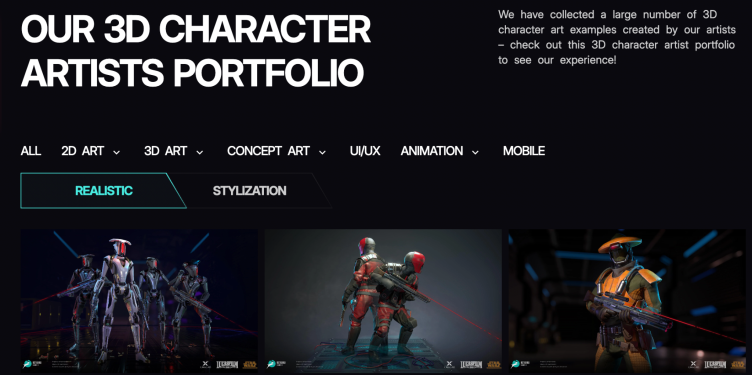
With other services, such as game development, testing, or porting, it’s not that easy. You have to look for a page with projects or case studies. At Kevuru Games’ website, we have a separate page for art and animation portfolio (exclusively visuals), and a Projects page, where we tell about our favorite projects in detail.
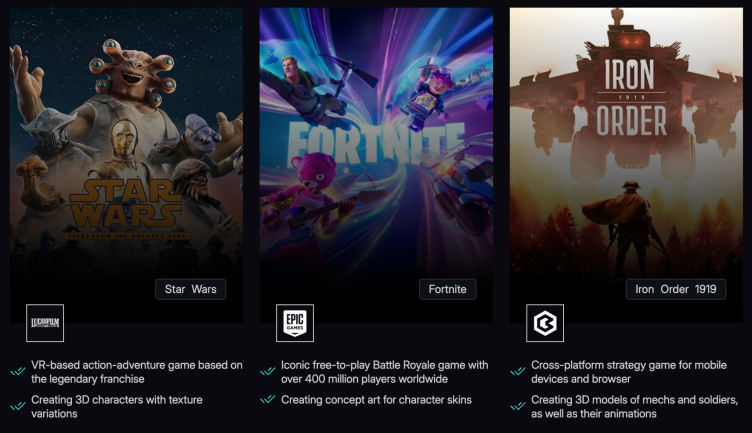
Pro tip: If you like the studio but doubt whether they have enough experience in your genre or style, ask them for a demo call. Usually, there will be more cases in their portfolio that are under NDA and can’t be shared publicly, but can be shown privately to prospective clients. From our experience, we can tell you that some of the most interesting projects are the ones we can’t show on our website portfolio.
Technical Expertise and Engine Experience
It may be hard to evaluate the tech expertise of a team when you’re not an expert in this field. But there are some tips to help you with that.
A team that spent the last five years building casual mobile games will approach a project very differently from a studio that primarily works on multiplayer PC and console titles.
The same engine can tell very different stories. One Unity team may have shipped dozens of mobile games. Another may use Unity for simulation products. A third may focus on AR and VR. The same goes for Unreal Engine. Placing a logo on a website is easy, so often you need to dig a bit more to understand what the team has actually done with it.
If your project already has technical requirements, ask about them directly. Have they shipped games on your target platform? Have they built multiplayer systems before? Have they worked with live-service infrastructure? Have they ported games between platforms? Specific questions usually lead to more useful answers than asking whether a studio has experience with a particular engine.
Team composition and size
When talking about a team, bigger is not always better. Smaller teams often have better communication between them and have less bureaucracy. But big teams often give more opportunities to pick professionals who have more relevant experience, or scale easier. When working with a small studio, it’s possible that you’ll have to find another one when you want to add something unusual to your game, port it to another platform, and so on. With a bigger one, it’s likely that you can continue working with them even when tasks and scope change.
At Kevuru Games, we have 64 professionals, and when we pick a team for a new project, we can always find the experts that suit it best, be it a project for 3 people or for 30.
Most clients like having direct access to all team members and not just the project manager. Yet you shouldn’t underestimate the importance of a good PM: with a team of people you don’t know well, it’s best to have someone responsible for meeting deadlines and implementing feedback.
Communication and Project Management
Before you start a collaboration, there’s very little you can know about the communication and project management of the company you’re evaluating. Yet overall corporate culture and communication often show at the negotiation stage. If they take too long to answer your requests, come to the meetings unprepared, or don’t explain clearly all the conditions, you may expect the same during your future work. Good professional communication is a factor that often outweighs a stellar portfolio.
Here are some things to check regarding communication:
Does the company speak the same language as you? (literally). If it’s an outsourcing studio abroad, not all employees might speak fluent English. Make sure you have talked to other team members, not only salesmen.
Timezone overlap. Same here – consider beforehand how much time difference you can manage without hurting work. Some people say that a 5-6 hours difference is a benefit, as they can plan their feedback and response and avoid unnecessary back-and-forth messaging that keeps you busy all day but doesn’t let you focus on actual work. A 12-hour time difference is another thing. Not everybody can manage that.
Tools. Most companies will assure you that they will use whatever instruments you’re using, but it’s always better to check in advance. And if their workspace is set in the same software ecosystem as yours, it’s a big plus.
The same with processes. When you ask to explain their processes in detail, you can instantly tell whether a company has 1 year of experience or 15. And yes, you would prefer the one with more experience.
Client Reviews and References
Checking for reviews is an obvious thing to do, so let’s think of places where we can get the most reliable reviews for game development studios. Here are some websites to check:
- Clutch
- GoodFirms
- DesignRush
- The Manifest
- TechBehemoths
- SelectedFirms
- SuperbCompanies
- G2 (less common for service providers, but still worth checking)
- Google Reviews
- LinkedIn recommendations
You can notice that some reviews are written in recognisable AI-ish style, but that doesn’t mean they’re fake. Some clients want to share their experience but don’t want to spend half an hour answering all the questions on Clutch, so they use our friend ChatGPT for help. Even if they sound generic, a good review on Clutch is almost surely based on real collaboration.
Sometimes you can get a live reference through LinkedIn or personal contacts. Let’s say a company showed on its website a project with an X game publisher, and you happen to know someone from the X company. Don’t hesitate to ask them for a reference – that way, you get the most reliable information possible.
If you managed to get a contact for such a reference, here are the questions to ask them:
- Did the studio deliver on time?
- How accurate were the original estimates?
- How did they handle changes in scope or unexpected issues?
- Did the team proactively suggest improvements or simply follow instructions?
- How often did you interact with senior team members?
- How were bugs, delays, or quality concerns handled?
- Did the studio remain involved after launch?
- Would you work with this team again?
Engagement Models: How Top Game Development Studios Work
You may have already found the perfect studio, agreed on the technology stack, and even aligned on the creative vision. Then comes the question: how exactly are we going to work together? Here are the most common cooperation models and how they work.
Fixed Price vs. Time & Material
The first thing many clients ask is whether the project can be done at a fixed price.
The honest answer? Sometimes.
If you already have detailed requirements, a clear scope, and don’t expect major changes, fixed price can work perfectly well. We occasionally work this way ourselves. The problem is that games have a habit of changing during development. A feature that looked great on paper suddenly doesn’t work. A new idea appears halfway through production. Somebody decides multiplayer would be nice after all.
That is why many studios prefer Time & Material for larger projects. It is less comfortable from a budgeting perspective, but much more forgiving when reality starts interfering with the original plan.
Dedicated Team Model
Some clients are not looking for a game. They are looking for people. Maybe they already have producers, game designers, and technical leadership. What they are missing is six Unreal developers, three QA engineers, or ten artists.
Sometimes a company needs five engineers. Sometimes it needs twenty artists. Sometimes it needs a whole QA team for three months before launch. Hiring all those people internally is possible, but it is rarely fast.
The dedicated team model is often chosen when the project itself is expected to last longer than a few months. At that point, clients usually care less about individual tasks and more about having stable people on the project. Developers leave, artists take vacations, priorities change — somebody still has to keep the team running. With a dedicated team, most of that responsibility stays on the vendor side.
Co-Development
This is probably the most common model in modern game development, although players rarely notice it.
Let’s say a studio is making a game but needs help with character art. Or console porting. Or backend infrastructure. Instead of building a new department from scratch, they bring in another team.
Large games often involve several companies working together at the same time. One studio handles gameplay, another supports art production, a third helps with testing, and a fourth works on ports.
We’ve discussed the concept of co-development previously, but it’s worth noting that many studios of all types have a co-development option as well (we do, for sure).
Questions to Ask Before Signing a Contract
Hopefully, after checking all the things mentioned above, you’ve gotten to the direct negotiations and are on the final line to sign a contract. These are the last things you should ask.
1. What exactly is included in the estimate?
Ask the studio to walk you through the estimate line by line.
Does it include project management? QA? Bug fixing? Deployment support? Documentation? The more detailed the estimate is, the fewer surprises you’ll encounter later.
2. What is the revision policy?
Every project involves revisions, but how many are paid for? How is feedback collected, and what happens if the project requires more iterations than originally planned?
3. Who will actually work on the project?
Sometimes, the people joining the sales call are not the people building the game. Ask about the proposed team structure, seniority level, and whether key specialists are already available or still need to be assigned.
4. How does communication work?
How often will meetings take place? Who is your main point of contact? What tools are used for task tracking and reporting? You don’t need a perfect process. You need a process that everyone understands.
5. What are the biggest risks you see in this project?
This is one of our favorite questions.
An experienced studio will usually identify a few concerns immediately. Unrealistic timelines, technical uncertainty, multiplayer complexity, content volume, platform requirements — there is almost always something. The answer often tells you more about the team than a sales presentation ever will.
6. Can you provide client references?
Portfolio examples are useful. Conversations with former clients are better. Take a look at the previous section for tips on how to ask for references.
7. What would you do differently if this were your own project?
Good question that doesn’t get asked enough. Try it, and you’ll get a valuable insight.
What Separates Top Game Development Studios from the Rest?
There is no secret formula here.
Most successful studios simply do a lot of small things well. They estimate realistically. They communicate consistently. They solve problems before they become emergencies. They keep clients coming back.
One thing you’ll notice when looking through portfolios is that the strongest gaming development companies often have long-term relationships with the same clients. In game development, that usually says more than any award, ranking, or marketing claim.
If you’re currently evaluating development partners, feel free to reach out. We’ll be glad to discuss your project and share our perspective.